EMDR Therapy in Salt Lake City: What It Is and Who It Helps | The Salt Lake City Therapist
By Helen De-Lovely, LCSW — The Healing Haven SLC
If you've heard the acronym EMDR and wondered whether it's real, whether it's right for you, or whether it's something a therapist just does with their hands while you close your eyes — you're not alone. This post explains what EMDR actually is, how it works, and who tends to benefit from it, in plain language with no hype.
Key Takeaways
EMDR stands for Eye Movement Desensitization and Reprocessing — a structured therapy developed to help people process traumatic or distressing memories.
It is recognized as an effective treatment for PTSD by the World Health Organization (WHO), the VA/DoD (2023), and major international guidelines.
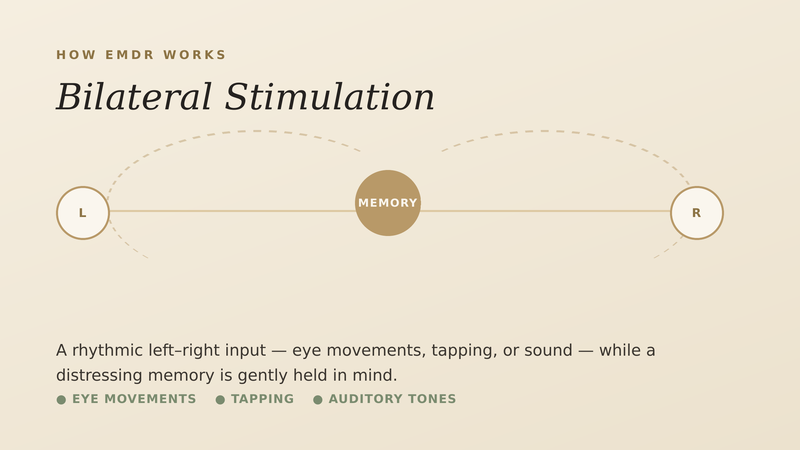
EMDR uses bilateral stimulation (eye movements, tapping, or sound) while you revisit a distressing memory, which appears to help the brain finish processing it.
It is used for PTSD, trauma, anxiety, and increasingly for other conditions — research is ongoing for broader applications.
Helen De-Lovely, LCSW offers EMDR at The Healing Haven SLC, both in person in downtown Salt Lake City and online across Utah.
The best first step is a free 15-minute consultation: helendelovely.com/consult.
In This Article
What is EMDR, exactly?
How does EMDR work? The basics of bilateral stimulation
What conditions does EMDR help with?
Who is a good fit for EMDR?
How to start EMDR in Salt Lake City
The Healing Group Membership
Frequently asked questions
What Is EMDR, Exactly?
EMDR — Eye Movement Desensitization and Reprocessing — is a structured psychotherapy developed in the late 1980s by psychologist Francine Shapiro. The central idea is that some distressing experiences, especially traumatic ones, don't get fully processed by the brain at the time they happen. Instead of being stored as ordinary memories, they stay "stuck" in a raw, fragmented form — and they can keep showing up as flashbacks, body sensations, nightmares, or reactive emotions long after the event has passed.
EMDR is designed to help the brain finish processing those stuck memories. It does this through a combination of structured preparation, guided recall of the distressing memory, and bilateral stimulation — a rhythmic back-and-forth input to both sides of the brain simultaneously.
EMDR is not hypnosis. You are awake and in control throughout the session. You do not have to describe the memory in detail if you don't want to. And it is not about reliving trauma for its own sake — the goal is to help the memory lose its emotional charge so it can be stored like any other past event.
How Does EMDR Work? The Basics of Bilateral Stimulation
The Eight Phases
EMDR follows a structured eight-phase protocol:
History and treatment planning — Your therapist gets to know your history, your goals, and the specific memories or experiences you want to work on.
Preparation — You and your therapist build a foundation of coping skills and a sense of safety before touching difficult material.
Assessment — You identify a specific memory to target, along with the negative belief it produced ("I am not safe," "It was my fault") and a positive belief you'd like to hold instead.
Desensitization — This is where bilateral stimulation happens. You hold the memory in mind while your therapist guides your eyes back and forth, or uses tapping, hand buzzers, or auditory tones. You follow what comes up without trying to control it. Sets of stimulation continue until the distress associated with the memory decreases significantly.
Installation — The positive belief ("I am safe now," "I did the best I could") is strengthened and linked to the memory.
Body scan — You check in with your body for any remaining tension or distress connected to the memory.
Closure — The session is wrapped up with grounding and stabilization, whether or not the memory is fully processed that day.
Re-evaluation — At the next session, you and your therapist check in on how things have shifted.
Why Bilateral Stimulation?
The exact mechanism is still being studied. One leading theory — the Working Memory model — suggests that holding a distressing memory in mind while performing a dual-attention task taxes the brain's working memory, which reduces the vividness and emotional intensity of the memory. Another theory connects bilateral stimulation to the rapid eye movement (REM) sleep state, during which the brain naturally processes emotional experiences.
What the research consistently shows is that the combination of structured memory processing and bilateral stimulation produces meaningful reductions in trauma symptoms for many people — and that those gains tend to hold over time.
What Conditions Does EMDR Help With?
PTSD
EMDR has its strongest evidence base for post-traumatic stress disorder (PTSD). It is recommended as a first-line treatment for PTSD by:
The World Health Organization (WHO) (2013 guidelines)
The VA/DoD Clinical Practice Guideline for PTSD (most recently updated 2023)
The International Society for Traumatic Stress Studies (ISTSS)
The UK National Institute for Health and Care Excellence (NICE)
The American Psychological Association's (APA) 2025 clinical practice guideline lists EMDR as a conditionally recommended (second-line) treatment for PTSD, while cognitive processing therapy, prolonged exposure, and trauma-focused CBT are strongly recommended as first-line approaches. A 2025 critique in the Journal of EMDR Practice and Research argues the APA's rating underrepresents EMDR's actual evidence strength — a live debate worth knowing about, though it doesn't change that EMDR remains a recommended, evidence-based option either way.
Trauma and Complex Trauma
Beyond PTSD's diagnostic criteria, many people carry distressing memories from childhood, relationships, accidents, or medical experiences that shape how they feel and function today. EMDR can help with this broader category of trauma, including what clinicians sometimes call complex or developmental trauma.
Anxiety
Growing research supports EMDR for anxiety disorders, including specific phobias and panic. The theory is that many anxiety responses are rooted in past experiences, and processing those experiences with EMDR can reduce the anxiety response connected to them.
Other Applications
Research is expanding into EMDR for depression, grief, chronic pain, and somatic symptoms. These applications are promising but have smaller evidence bases than the PTSD research. A 2024 meta-analysis of 25 randomized controlled trials (1,042 participants) found a significant effect on depression symptoms, with stronger results in more severe cases. At The Healing Haven SLC, Helen uses EMDR within a broader somatic and trauma-informed approach, integrated with other nervous-system tools.
Who Is a Good Fit for EMDR?
EMDR tends to be a good fit for people who:
Have specific memories, events, or experiences they want to process
Notice that past events still produce strong emotional or physical reactions today
Feel "stuck" in patterns of anxiety, shame, or hypervigilance even though they understand intellectually that the event is over
Have tried talk therapy and want to try something that works more directly with the body and memory
Are ready to do some active processing, even if it is uncomfortable at first
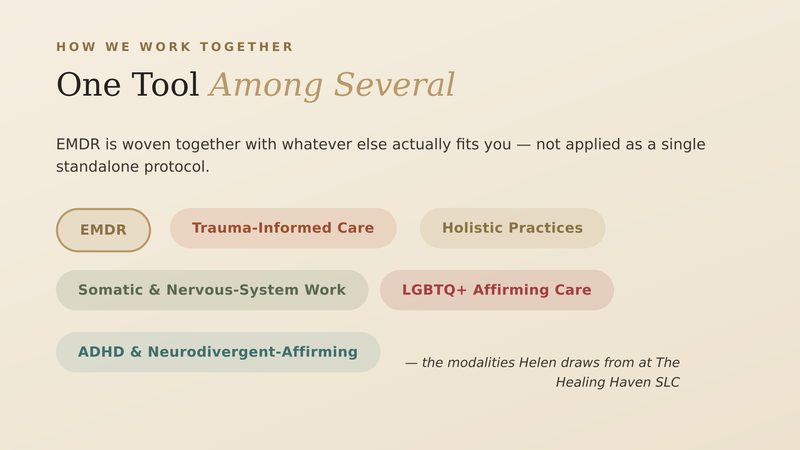
EMDR is also used with neurodivergent clients, including people with ADHD and autism. Pacing, sensory preferences for bilateral stimulation, and processing style may be adjusted to fit each person. This is something Helen takes seriously at The Healing Haven SLC.
How to Start EMDR in Salt Lake City
Helen De-Lovely, LCSW offers EMDR at The Healing Haven SLC — in person in downtown Salt Lake City (250 E 200 S, Suite 1521) and online for clients anywhere in Utah.
The first step is a free 15-minute consultation to talk about what you're dealing with, ask questions, and see whether working together feels like a good fit: helendelovely.com/consult.
The Healing Group Membership
The Healing Haven SLC offers a Healing Group Membership at $29/month — a month-to-month membership (cancel anytime) that includes access to group sessions, community, and member resources.
The membership is not insurance and does not cover therapy sessions by itself.What it does do is lower the per-session rate for individual therapy. Members pay $123 per session instead of the standard private-pay rate of $189 per session. Some new members also receive a one-time bonus session at signup — ask about current availability.
The Healing Haven SLC is out-of-network for commercial insurance plans. Superbills are provided for clients who want to seek possible reimbursement through their insurance's out-of-network benefits. Utah Medicaid is accepted directly after verification.
Learn more: helendelovely.com/membership
Ask a Therapist
"People often ask me if EMDR is real — or if it's something I just made up with hand gestures. It's one of the most research-supported trauma treatments we have, recommended by the WHO and the VA, and in my practice it's changed things for people who had tried every other approach. If you're curious whether it's right for you, that's exactly what a free consult is for."
Frequently Asked Questions
Is EMDR covered by insurance?
The Healing Haven SLC is out-of-network for commercial insurance plans. You pay directly and receive a superbill you can submit to your insurance for possible out-of-network reimbursement. Utah Medicaid is accepted directly after verification. See session rates above or visit helendelovely.com/membership.
How many EMDR sessions will I need?
There is no universal answer — it depends on what you are working on, your history, and how processing goes. Some people notice significant shifts in a handful of sessions; others work over a longer period, particularly with complex or developmental trauma. Helen will give you an honest sense of what to expect during your consultation and as treatment progresses.
Do I have to talk about my trauma in detail for EMDR to work?
No. EMDR does not require you to narrate your experience in detail. You hold the memory in mind internally while your therapist guides the bilateral stimulation. You can share what comes up, but there is no requirement to describe the trauma verbally or relive it in full.
Is EMDR only for PTSD?
EMDR has the strongest research base for PTSD, but clinicians use it for a range of trauma-related concerns, anxiety, and other conditions. Research into broader applications is growing. Helen works with trauma of all kinds, not only PTSD diagnoses.
Can EMDR be done online?
Yes. Helen offers online sessions across Utah. Bilateral stimulation in telehealth EMDR is typically delivered through a screen-based eye movement tool or self-administered tapping guided by the therapist. Research supports its effectiveness online.
What is the difference between EMDR and somatic therapy?
Somatic therapy focuses broadly on body sensation and nervous-system regulation. EMDR is a structured protocol for processing specific memories, though it also attends to body sensation. Helen integrates both — using somatic tools to support the nervous system before and during EMDR processing.
This blog post is for general educational and informational purposes only. It is not a substitute for professional mental health assessment, diagnosis, or treatment. Reading this post does not establish a therapist-client relationship. If you are in crisis, please call or text 988 (Suicide and Crisis Lifeline) or go to your nearest emergency room.