Finding an LGBTQ+ Affirming Therapist in Salt Lake City
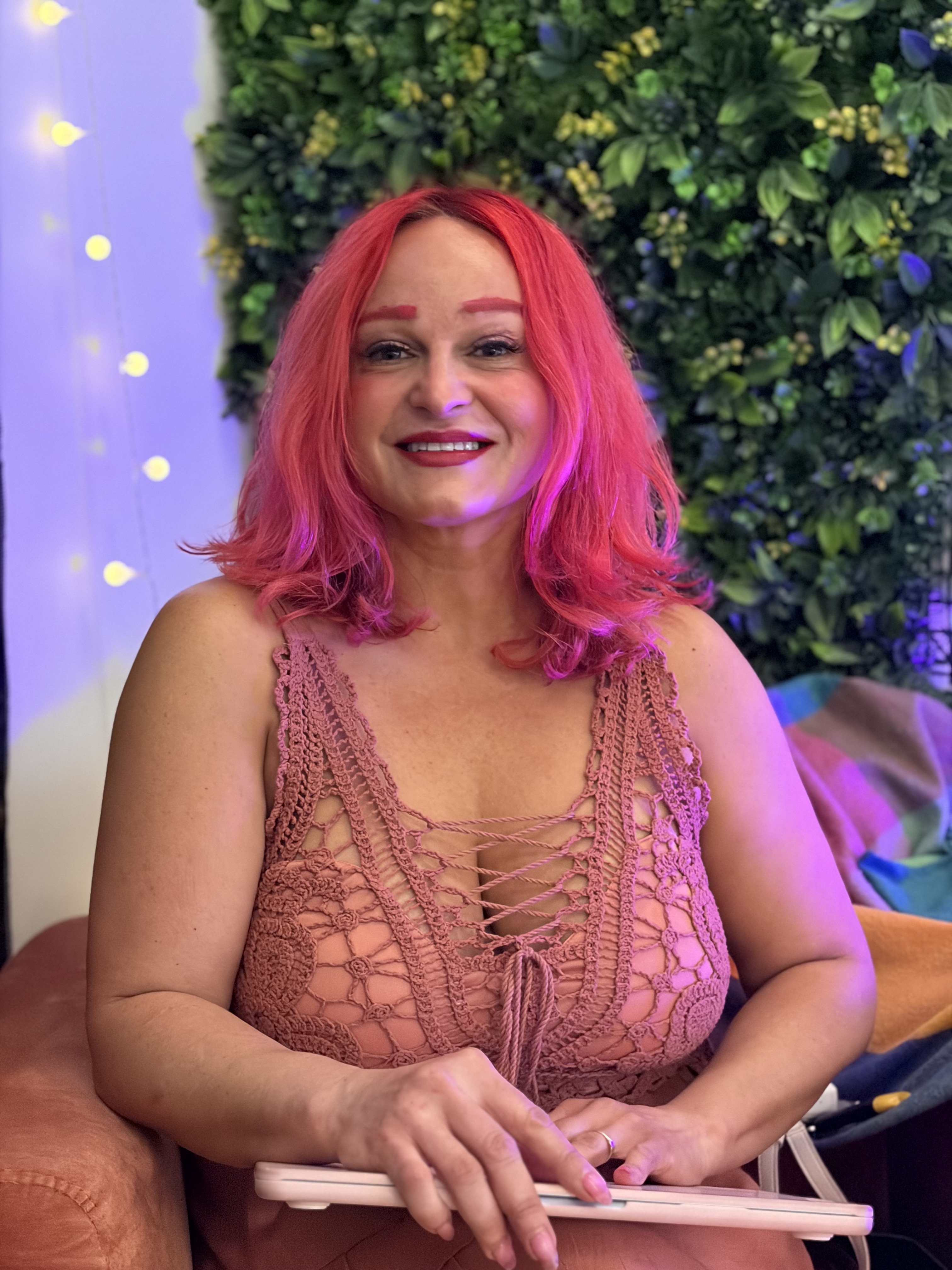
By Helen De-Lovely, LCSW — The Healing Haven SLC
There's a specific kind of tired that comes from explaining yourself.
Explaining your pronouns. Explaining your partner. Explaining why the holidays are complicated, why you left your hometown, why you flinched when the intake form only had two boxes. And if you've ever done that explaining in a therapist's office — the one room that was supposed to be safe — you know it's a tiredness that sits somewhere deeper than sleep can reach.
I'm Helen. I'm a therapist in downtown Salt Lake City, and I want to talk about what "LGBTQ+ affirming" actually means — because the phrase is on a lot of websites, next to a lot of small rainbow icons, and it does not always mean the same thing once you're in the room. My hope is that by the end of this post you'll know exactly what you're allowed to look for, ask for, and walk away from.
Key Takeaways
- Affirming therapy means your identity is never the problem being treated. It's the context, not the diagnosis.
- "Tolerant" and "neutral" are not the same as affirming — and the difference is something you can feel in the first session.
- Minority stress is real. A good therapist names it instead of making you carry it alone — or worse, adding to it.
- You are allowed to interview a therapist. Direct questions before booking are not rude; they're wise.
- On gender-affirming support: every practice offers different things, so ask in your consult what's offered here.
- The Healing Haven SLC was built to be a room where you never have to explain, shrink, or perform. That's not a specialty we added — it's the foundation.
What "Affirming" Actually Means (and What It Doesn't)
When I was building The Healing Haven and started thinking about the practitioners I'd eventually hire, I wrote down a short list of things that had to be true about every single one of them. Near the top: they had to be neurodivergent- and queer-affirming. When someone asked me about that on our podcast, my answer was three words:
"It's non-negotiable."
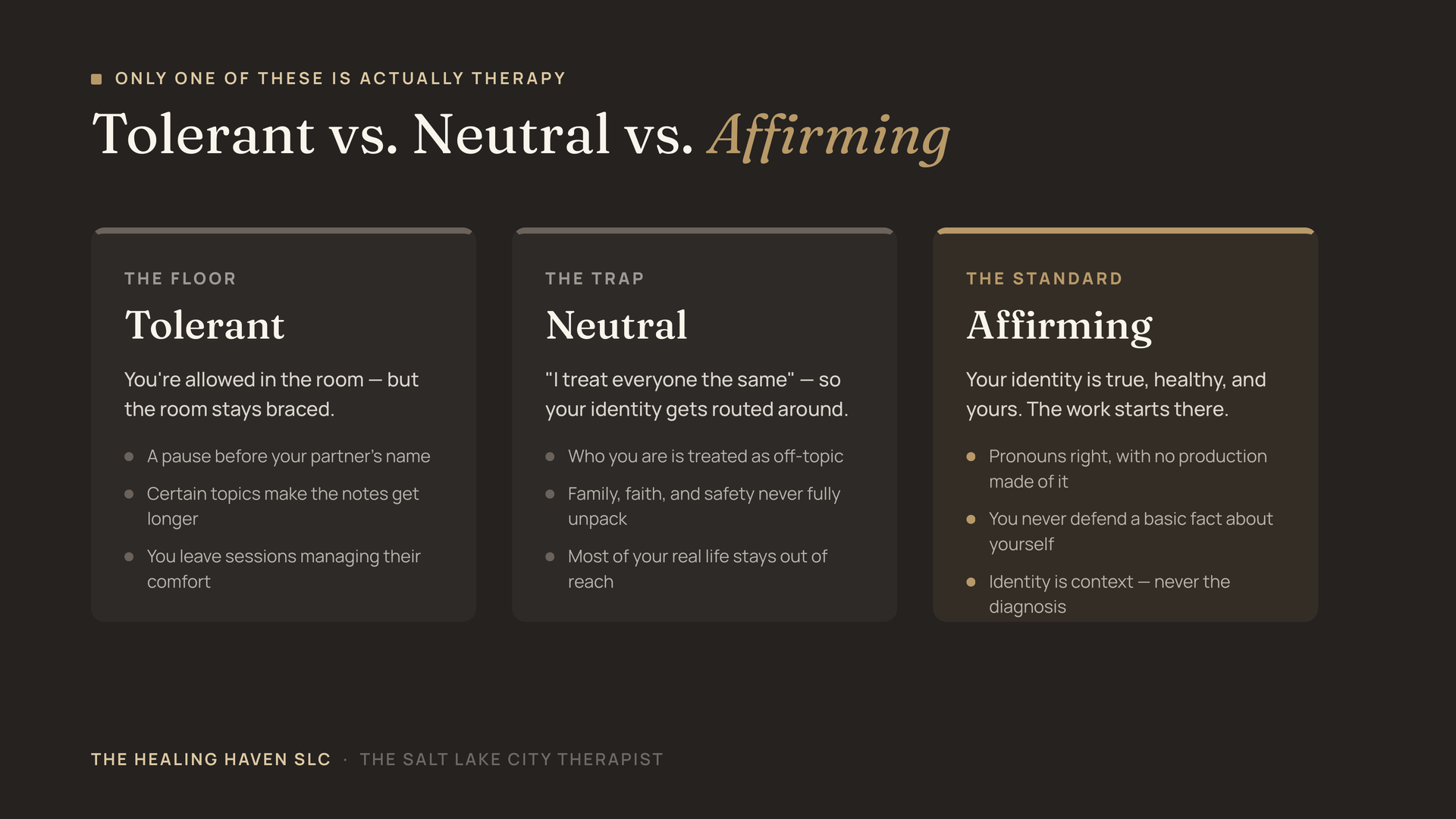
Here's why I hold it that tightly. In my experience, therapists tend to relate to LGBTQ+ clients in one of three ways — and only one of them is actually therapy.
Tolerant means the therapist will see you, but something in the room stays braced. You catch the pause before your partner's name. You notice which topics make their notes get longer. Tolerance is being allowed in the room. It is not being welcome in it.
Neutral sounds better — "I treat everyone the same!" — but neutral means your therapist has decided your identity is a topic to route around. The problem is, your life doesn't route around it. If your family, your faith history, your safety calculations, and your love life all pass through who you are, then a therapist who stays "neutral" about who you are can't actually reach most of your life.
Affirming means your identity is treated as true, healthy, and yours — full stop — and the work starts from there. Not a symptom to investigate. Not a phase to wait out. Not a topic anyone in the room is managing. In practical terms: your pronouns are used correctly without a production being made of it, your relationship structure is met matter-of-factly, and you will never be asked to defend a basic fact about yourself. Anything with even a whiff of trying to change who you are has no place in therapy — not subtly, not "just exploring," not ever.
No Judgment: The Rule Underneath Everything I Do
People ask me what "trauma-informed" means, and I always come back to the same place. You don't know anyone's trauma. You haven't been there. You can't assume what someone is feeling, and you don't know how far an experience reached into a person's life.
Ask a Therapist: "There can be no judgment. The person explaining the experience is correct in their perception."
— Helen, on The Healing Haven podcast
Years ago, I worked in hospice care. One of the first things they taught me was this: when someone has lost a loved one, you never say I know how you feel. You don't. You can't. Your job is to sit with them inside their experience, not to file it under yours.
I've carried that into every hour of therapy I've done since — and I want you to hear what it means if you're a queer or trans person reading this. It means when you tell me what it was like coming out, or not coming out, or being somewhere you couldn't be fully yourself, I'm not measuring your story against a template. Your perception is correct. You were there. My job is to believe you first and help second.
And it means the work stays gentle. I said this on the podcast about the people I work with, and I'll stand by it here: we are gentle beings. There's no reason to be rough — or to help someone get used to living in fight or flight. How does that help us? If you've spent years braced, therapy should be the first room where you get to un-brace. Not one more place that asks you to perform resilience.
The Utah Part
I'm not going to grandstand about Utah. You live here. You already know.
What I'll say is this: a lot of people I sit with are holding real love and real hurt from the same source — a family they're still attached to, a faith community that raised them, a hometown that shaped them. Those things don't sort into neat piles, and you shouldn't have to spend your sessions explaining to your therapist why they don't. Here, that context is simply part of the room. You say "my family" with that particular weight in your voice, and I know we're not starting from zero.
The stress of navigating all of it has a name — researchers call it minority stress — and it's not a character flaw or fragility. It's the documented, cumulative load of scanning rooms, editing sentences, and doing safety math that other people never have to do. The Trevor Project's Utah research has found that a large share of LGBTQ+ young people in this state wanted mental health care in the past year and couldn't get it. That gap is exactly why I think it matters to say plainly what affirming care is, and where to find it.
Salt Lake City also holds a real community — visible, resourceful, and generous with each other. Both things are true here. Good therapy in Utah makes room for both.
For the Person Who's Been Looking Forever
Maybe you've already tried therapy. Maybe more than once. Maybe you had a therapist who was kind but you still left sessions with the feeling that some part of you had waited in the car.
When I describe who The Healing Haven is for, this is what I say:
Ask a Therapist: "The Healing Haven is really designed for that client that's been looking forever — that knows what they want, and knows how they need to feel in order to heal."
— Helen, on The Healing Haven podcast
If you've burned out on searching — filtered the directories, read the bios, tried the therapist with the rainbow icon who still asked you to explain what nonbinary means — I want you to know that the looking itself makes sense. You weren't being picky. You were doing the thing your nervous system is built to do: checking whether a room is safe before you set something precious down in it.
You don't have to talk yourself out of that instinct. You just need a room that passes the check.
I Know What It's Like When a System Isn't Built for You
I'll share one piece of my own story, because I think it matters here.
I grew up in foster care. I know — from the inside — what it's like to move through systems that were supposed to help and often didn't, to be surrounded by adults making decisions about your life, and to learn very young how to read a room for safety. On the podcast I put it this way: you're going to see a success story. I am one too. I was in foster care.
I'm not saying my story is your story. That hospice lesson holds — I will never tell you I know how you feel. But if you've had to survive inside institutions and expectations that weren't built with you in mind, and you've wondered whether a therapist could actually get what that does to a person: that's not an abstract concept to me. It's part of why I do this work the way I do it — and part of why nobody in my office has to earn their belonging by explaining it.
Questions You're Allowed to Ask a Therapist Before Booking
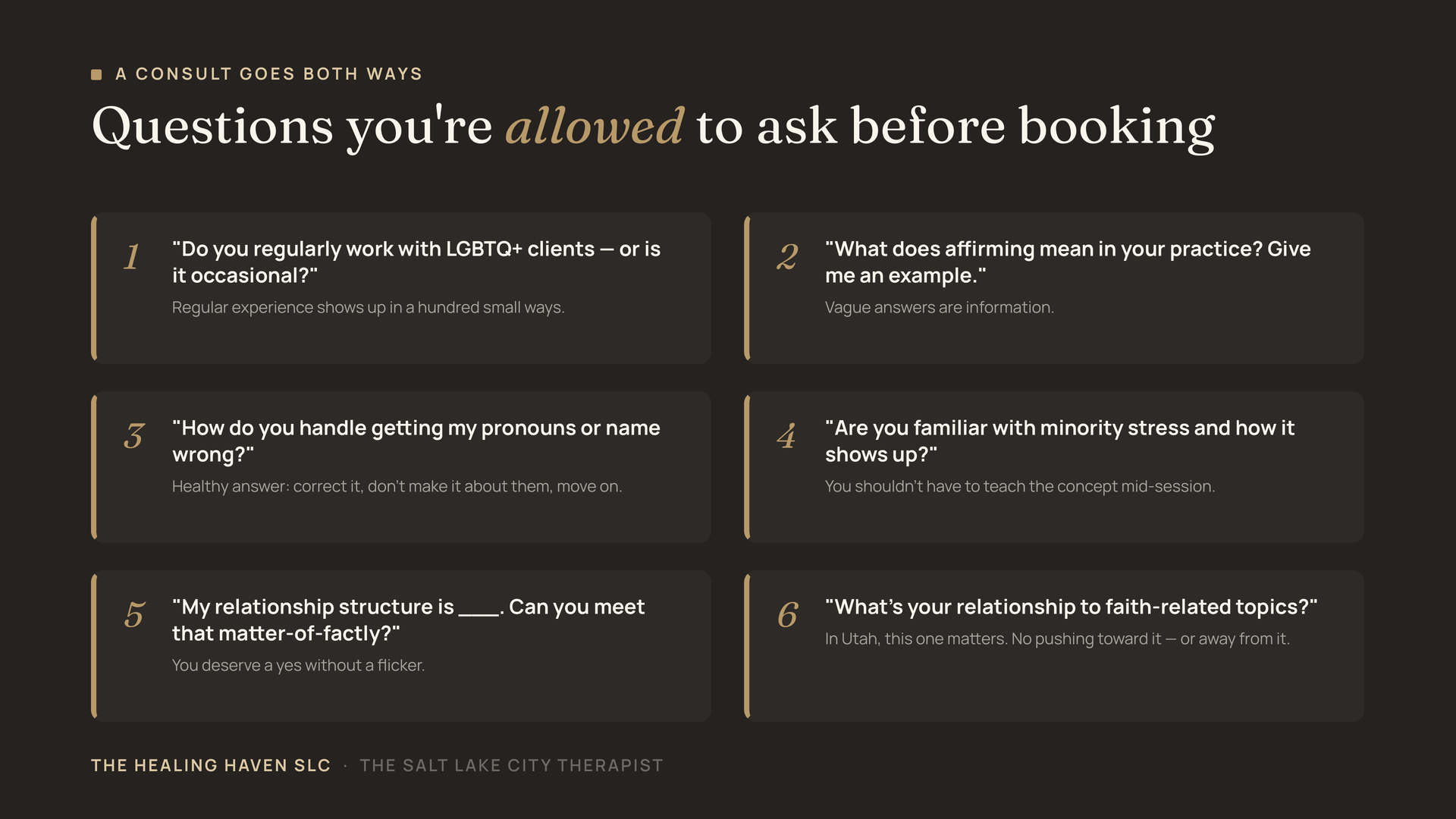
You are allowed to interview us. I mean that. A free consult is not an audition you're trying to pass — it's you, checking the room. Ask directly:
- "Do you regularly work with LGBTQ+ clients, or is it occasional?" Regular experience shows up in a hundred small ways.
- "What does affirming mean in your practice — can you give me a concrete example?" Vague answers are information.
- "How do you handle it if you get my pronouns or name wrong?" The healthy answer is simple: correct it, don't make it about them, move on.
- "Are you familiar with minority stress and how it shows up?" You shouldn't have to teach the concept mid-session.
- "My relationship structure is ___. Is that something you work with matter-of-factly?" You deserve a yes without a flicker.
- "What's your relationship to faith-related topics?" In Utah, this one matters. You want someone who can hold religion as a complicated inheritance — without pushing you toward it or away from it.
A genuinely affirming therapist will answer all of these directly, without defensiveness, and without making you feel strange for asking. If a consult leaves you managing the therapist's feelings about your questions — that's your answer.
A Note on Gender-Affirming Support
If you're trans, nonbinary, or questioning, you may be looking for particular kinds of support alongside therapy. Every practice offers different things, and I'd rather be straightforward than promise on a webpage what belongs in a conversation: ask in your consult what's offered here. That conversation is free, it's fifteen minutes, and you'll get direct answers — including honest referrals if what you need is something another provider does better.
What I can promise on this page: your gender is real here, your name and pronouns are used from day one, and no part of working with me will ever involve someone trying to talk you out of who you are.
The Rainbow Room
One more thing I want you to know exists, because therapy isn't the only room that helps.
The Healing Haven hosts the Rainbow Room — a warm, affirming LGBTQ+ group space, accessed through the Healing Haven app. It's a place to connect, exhale, and just be yourself. No pressure to share. Nothing to perform. Just a supportive room where you can show up as you are.
I'll be honest: I would have loved to have found a room like that years ago — a room where I didn't have to explain, shrink, or perform. I think a lot of us would have been in a different place if we'd known one existed. That's why it matters to me.
If you're curious, ask about it in your consult or reach out through the Healing Haven app and we'll point you to the current gatherings.
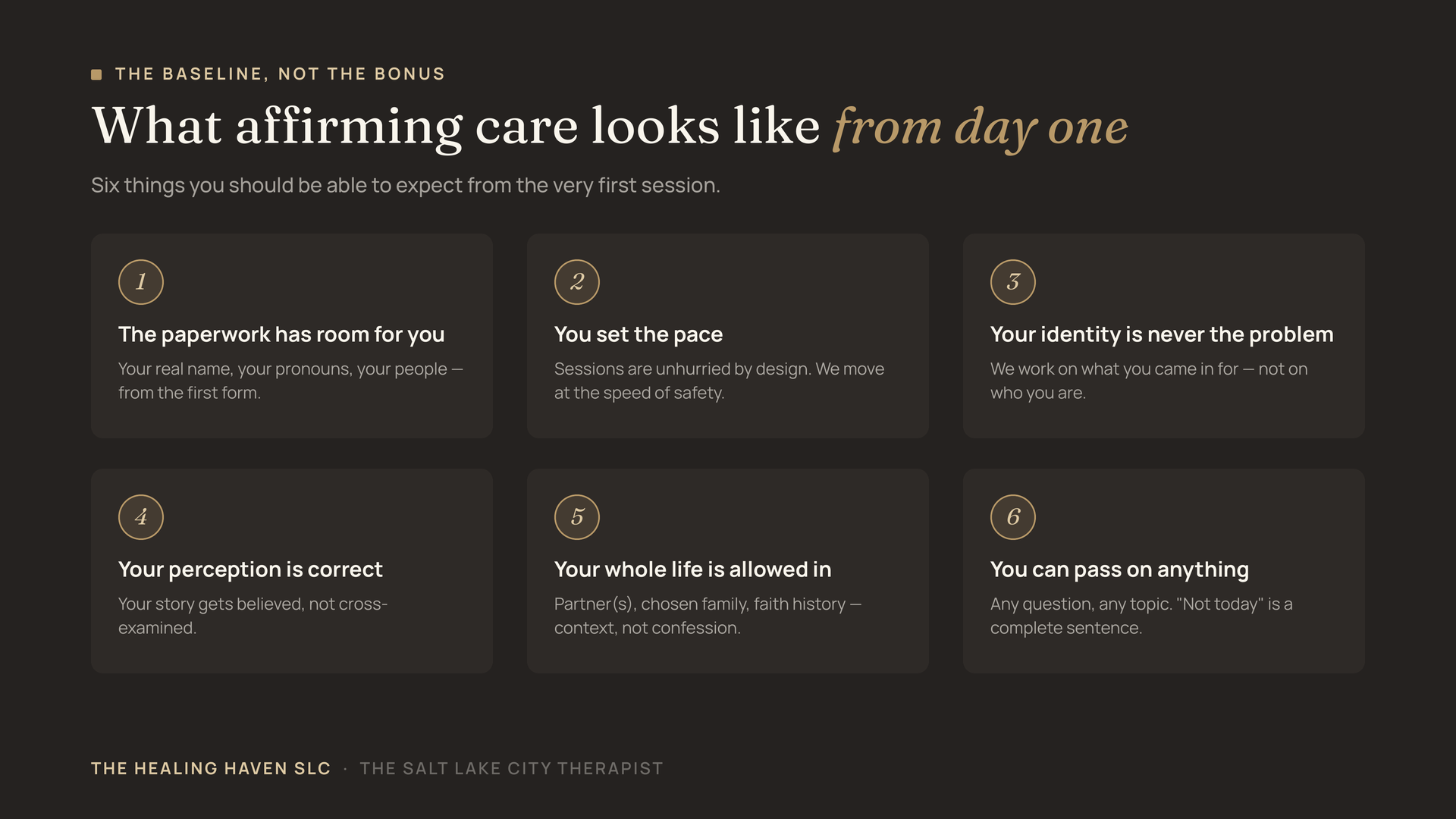
What Affirming Care Looks Like From Day One
Not after you've proven yourself. Not once trust is "established." Day one:
- The paperwork already has room for you. Your name — the real one — your pronouns, your people.
- You set the pace. First sessions here are unhurried by design. We move at the speed of safety.
- Nothing about your identity gets flagged as a problem. We work on what you came in for.
- Your perception is treated as correct. Your story doesn't get cross-examined.
- Your whole life is allowed in. Partner(s), chosen family, faith history, the group chat — context, not confession.
- You can pass on anything. Any question, any exercise, any topic. "Not today" is a complete sentence.
How to Start
The Healing Haven SLC is in downtown Salt Lake City — 250 E 200 S, Suite 1521 — with telehealth available across Utah. Sessions are Monday through Thursday by appointment. The work here is trauma-informed, somatic, neurodivergent-affirming, and LGBTQ+ affirming — not as a specialty tacked on, but as the foundation everything else is built on.
The first step is a free 15-minute consultation. Bring your questions — including every one on the list above. No commitment, no pressure, and if we're not the right fit, I'll tell you honestly and help you find who is.
Sessions are $189, and members pay from $123 per session — learn about membership here. The Healing Haven SLC is out-of-network for commercial insurance plans and provides superbills for possible out-of-network reimbursement. Utah Medicaid is accepted directly after verification.
Frequently Asked Questions
Do I need a label to book a session?
No. You don't need a label, a diagnosis, or a fully worked-out identity. Questioning, fluid, mid-process, "none of these words fit me" — all welcome. You get to be a work in progress here.
What if I'm not out — or can't be?
Then that reality gets respected, not pushed. Coming out (or not) is yours to decide, on your timeline, weighing safety factors only you can see. Therapy is also a confidential place to think that through with someone who has no agenda about your answer.
Is what I share confidential?
Yes. Confidentiality is a legal and ethical obligation, with the standard exceptions (like imminent risk of harm), which I'll explain plainly before we begin. What you share about your identity and relationships stays in the room.
I've been burned by an "affirming" therapist before. Why would this be different?
That experience is common, and I'm sorry you had it. I won't ask you to take my word for anything — that's what the free consult is for. Ask the hard questions and watch how they're answered. You're not obligated to book, return, or explain yourself.
Do you work with trans and nonbinary clients?
Yes. And for specifics about gender-affirming support beyond therapy itself, ask in your consult what's currently offered — you'll get a direct answer.
Do you take insurance?
The practice is out-of-network for commercial plans; superbills are provided for possible out-of-network reimbursement. Utah Medicaid is accepted directly after verification. Members pay from $123 per session instead of the standard $189.
You're invited: The Grand Opening
Before you go — come meet the practice in person. We're celebrating with an open house: food, tours of the space, and a chance to put a face to everything you just read.

Register for the Grand Opening → — September 18, 5–7pm, Hyatt Regency Salt Lake City.
This post is for general educational and informational purposes only. It is not a substitute for professional mental health assessment, diagnosis, or treatment, and reading it does not create a therapist-client relationship. If you are in crisis or thinking about suicide, call or text 988 (Suicide & Crisis Lifeline) — LGBTQI+ callers can press 3 or text PRIDE for affirming support. For emergencies, call 911.