
What Is Somatic Therapy? A Salt Lake City Therapist Explains
By Helen De-Lovely, LCSW — The Healing Haven SLC
A client said something the other day that I keep thinking about. We were working with the crystal sound bowls in my somatic room, and afterward they told me that one note had brought up anxiety — and the very next note soothed it.
One note stirred it up. The next one settled it. Nothing was said out loud. Their body did all of that on its own.
That, honestly, is somatic therapy in one moment: your body knows things, feels things, and holds things — sometimes before your thinking mind has any words for them. Somatic work is simply therapy that stops ignoring that.
I'm Helen De-Lovely, a licensed clinical social worker in Salt Lake City, and somatic work is at the center of how I practice. People ask me all the time what it actually is — is it massage? Is it meditation? Is it going to be weird? So instead of giving you a textbook definition, let me walk you through what actually happens in my somatic room.
Key Takeaways
- Somatic means "of the body." Somatic therapy is any therapeutic work that connects your emotions to your body — breath, sensation, sound, movement, visualization — alongside regular talk therapy.
- Trauma and chronic stress live in the nervous system, not just in your thoughts. That's why you can understand your patterns perfectly and still feel stuck.
- At The Healing Haven SLC, somatic sessions are client-led — they start with "what do you want to work on today?" — and nobody is ever required to do somatic work they don't want.
- Sessions can include guided visualization, breath work, and crystal sound bowls in our dedicated somatic room, with optional holistic elements like Reiki — always your choice, never a requirement.
- Somatic work pairs naturally with EMDR and trauma-informed talk therapy, and many people find it helpful for trauma, anxiety, burnout, and ADHD-related overwhelm.
- The first step is a free 15-minute consult — standard sessions are $189, member sessions from $123, and Utah Medicaid is accepted after eligibility verification.
In This Article
- What "Somatic" Actually Means
- Why Your Body Keeps the Score
- What a Somatic Session Looks Like in My Office
- Walk Through the Garden With Me
- Sound Bowls, Breath & the Somatic Room
- What "Regulating Your Nervous System" Really Means
- Trauma-Informed, Defined
- Who Somatic Work Tends to Help
- Somatic Therapy at The Healing Haven SLC
- The Healing Group Membership
- Frequently Asked Questions
What "Somatic" Actually Means
On our podcast recently, someone admitted to me: "I don't really know what somatic therapy is — but I'm attracted to it." I love that, because it's most people. The word is everywhere right now, and almost nobody defines it.
Here's my definition, the same one I gave on the podcast:
Ask a Therapist: "Somatic is what is felt within the body, and the connection to our emotions. It's anything that connects your emotions to your body."
That's it. The word comes from the Greek soma — body. And once you hear that definition, you realize somatic work is a much bigger umbrella than people think. Meditation and grounding are somatic. Breath work is somatic. Sound therapy — the bowls in my office — is somatic. Dance is somatic. Tai chi is somatic. It's experiential: you don't just talk about a feeling, you actually feel where it sits in your body and work with it there.
Somatic therapy is when a trained, licensed therapist weaves that body-awareness into real clinical work. It doesn't replace talk therapy. It sits alongside it. Some sessions in my office are almost all conversation. Some are almost all breath, sound, and stillness. Most are somewhere in between — and you get a real say in where the dial sits each week.
Why Your Body Keeps the Score
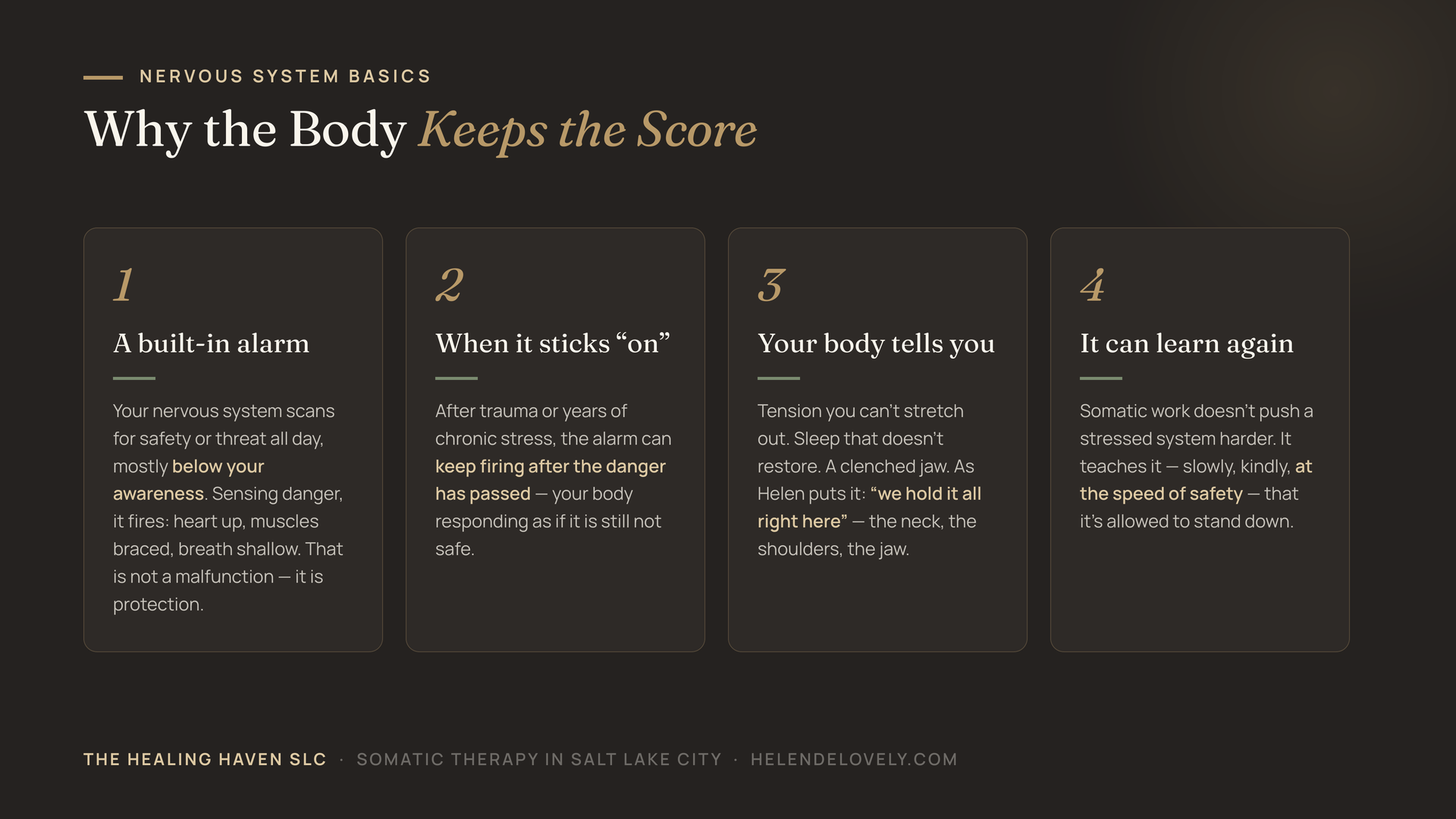
Your nervous system has one main job: keep you alive. It scans constantly for safety or threat, mostly underneath your awareness, and when it senses danger it fires up the stress response — heart rate up, muscles braced, breath shallow. That's not a malfunction. That's your body doing exactly what it was built to do.
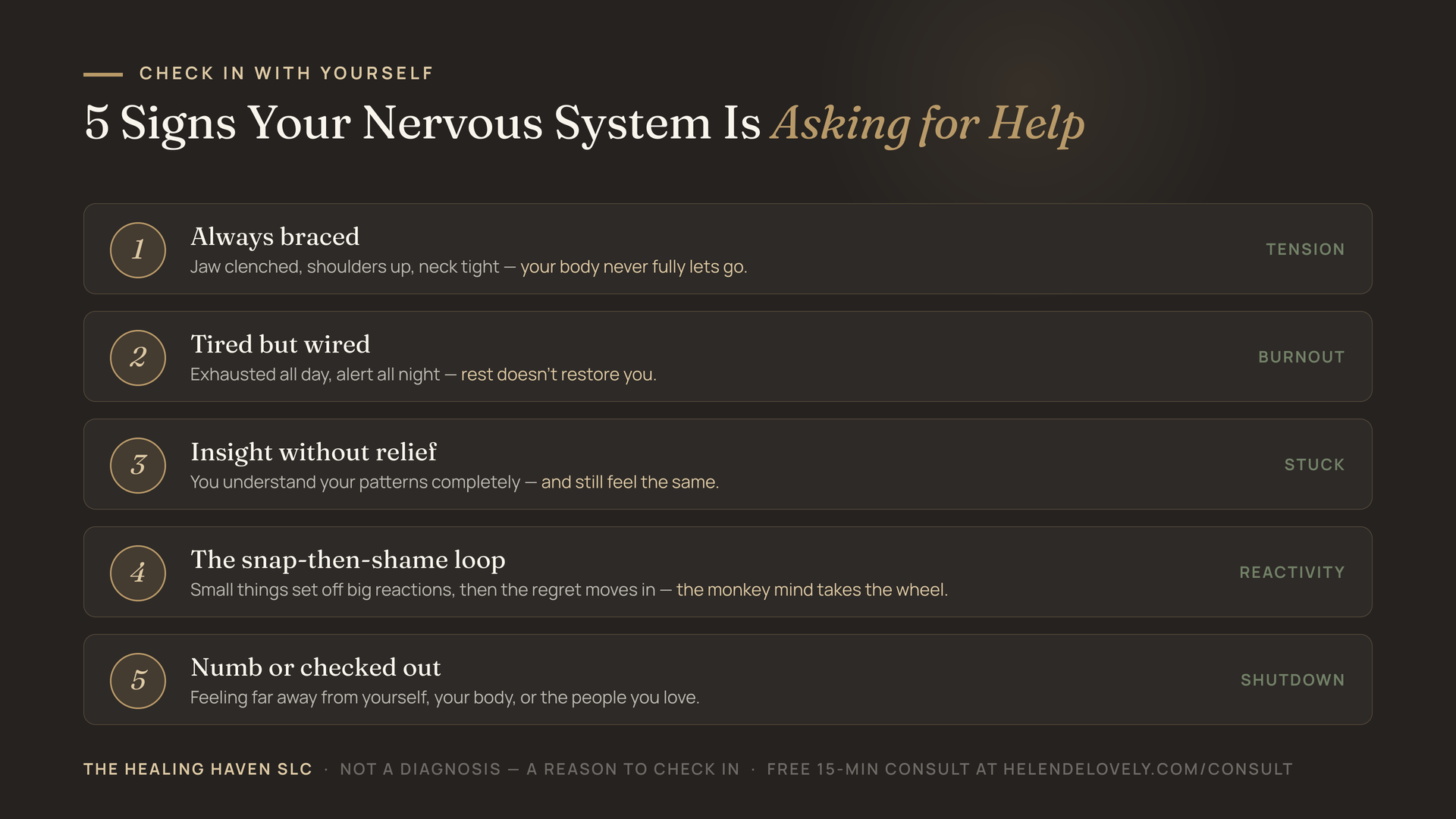
The trouble starts when the alarm doesn't fully switch off. If you've lived through trauma, or years of chronic stress, your body can keep responding as if the danger is still here — long after it's over. You feel it as tension you can't stretch out, exhaustion that sleep doesn't touch, a jaw that's always clenched.
I see this every week. So many of my clients carry ADHD or PTSD, and I'll tell you where it goes: we hold it all right here — the neck, the shoulders, the jaw. The body ends up telling the story the mind has been trying not to.
And here's the thing I say a lot, because I mean it: I don't believe in helping people get used to living in fight-or-flight. How does that help us? When we're stuck there, we're not our best self. We can't make good choices, we don't choose good relationships, we don't stand up for ourselves, and our creativity gets stifled — pretty much eliminated. You have to have water in your cup to create.
We are gentle beings. There's no reason for healing to be rough. So instead of pushing harder against a nervous system that's already overwhelmed, somatic work teaches it — slowly, kindly, at your pace — that it's allowed to stand down.
What a Somatic Session Looks Like in My Office
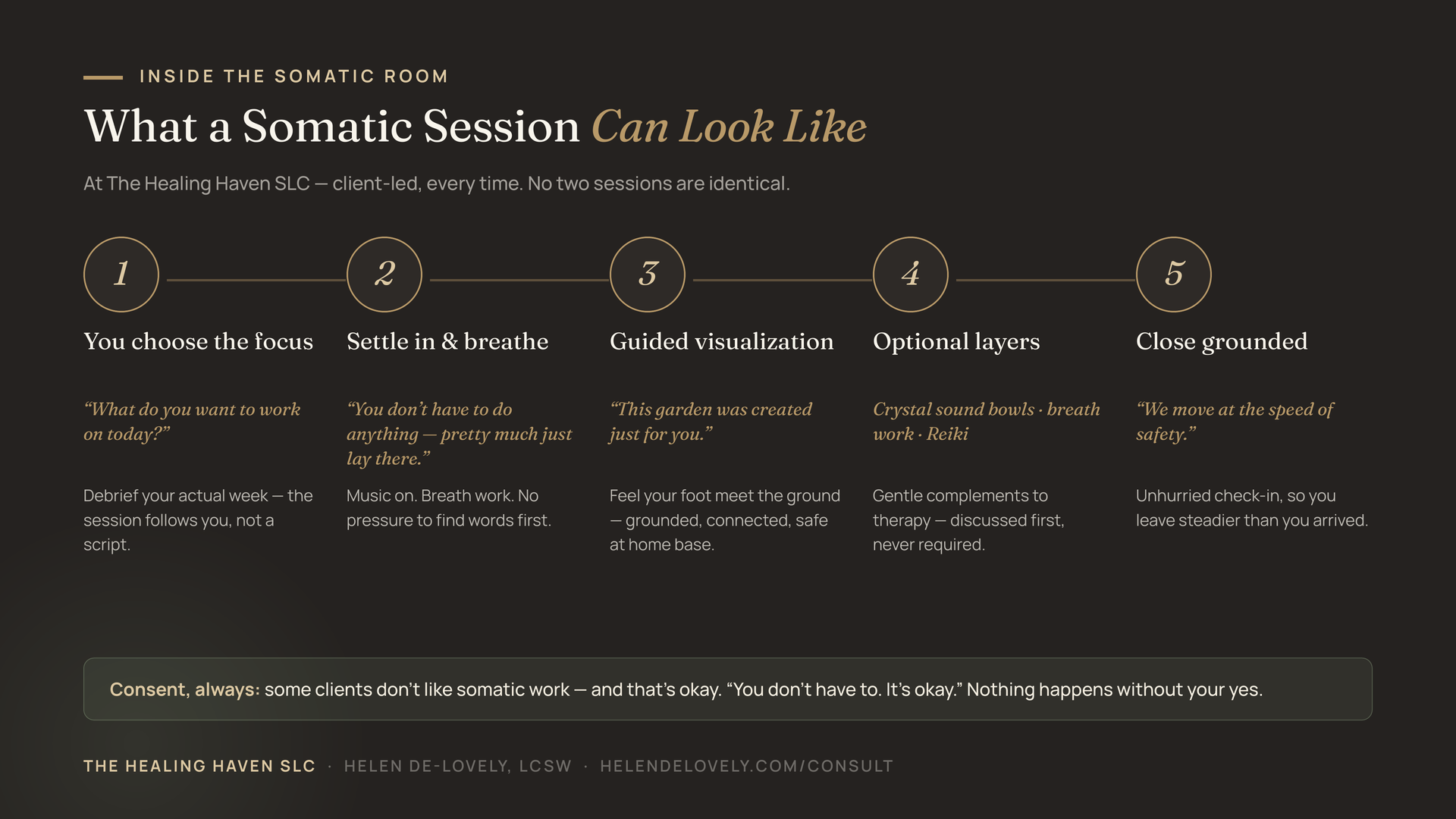
Here's something that surprises people: I don't walk in with a script.
Once a client and I have built the foundation — maybe we've done EMDR, maybe brainspotting, maybe visualizations — I'll open a lot of sessions the same way:
Ask a Therapist: "I will ask them: so, what do you want to do today? What do you want to work on today?"
It's the best. Some clients laugh and say "you choose." But that question matters, because it gives you the chance to debrief whatever you're actually carrying that week. I never want a session to be taken over by my agenda when your week had other plans.
And I'll tell you something else, because I think it builds more trust than any sales pitch: some of my clients don't like somatic work. Truly. I do a lot of somatic stuff, and I have clients who tell me it's not their thing. You know what I say? You don't have to. It's okay. Some of them get a little more open to it over time; some don't; both are fine. Nothing in my office happens without your consent, and nothing is required for therapy to "count."
But when a client walks in and really can't settle — can't even find the words to start talking — we don't force it. We just breathe. I'll put on music. I'll tell them: you don't have to do anything. Pretty much just lay there. And then I'll walk them somewhere, out loud, together.
Sometimes what we need most is another person to breathe with us — someone whose whole job is to slow down with you. Because honestly, where else in your week does anyone slow down?
Walk Through the Garden With Me
Let me actually show you. This is the visualization I like to start with — shortened, but in my words, the way I'd say it in the room.
Close your eyes if that feels okay.
There's a garden. It is so beautiful — it has the most beautiful flowers and plants, and the best smells you've ever smelled. And this garden was created just for you. It's your garden. Nobody else's.
What can you smell there? Maybe violets. What can you hear? A little bird chirping, maybe. Maybe a little water trickling somewhere. It's always nice to bring in a little water.
That garden is home base. When you're there, you're safe.
Then, when you're ready, I have you walk a path — and this is where it gets very somatic in the description. You watch your foot take that first step onto the ground. You feel it beneath you. You feel connected to the earth. One step. Then another. That feeling — your own weight, held by the ground — is part of the calming itself.
That's it. That's the "scary" somatic work people worry about: a garden, a path, your own two feet. Clients tell me they can smell the flowers within seconds. Your imagination is a nervous-system tool you've been carrying around your whole life — somatic therapy just teaches you to use it on purpose.
Someone I love once told me about an exercise from her bodywork training years ago: the class went to a park, paired up, and one partner closed their eyes while the other led them safely through the grass for an hour. She said, "I had just never felt my foot before. Every step was so grounding — even though I couldn't see." She never forgot it. That's the same principle: when the body leads and the busy mind has to follow, something in us finally gets quiet.
Sound Bowls, Breath & the Somatic Room
At The Healing Haven, we have a dedicated somatic room — a physical space at the practice set up for exactly this kind of work, with crystal sound bowls, room to lie down and breathe, and none of the fluorescent-lit clinical energy that puts nervous systems on guard.
Do people like the sound bowls? Absolutely. Remember my client from the top of this post — one note brought anxiety, the next note soothed it. I've felt versions of that myself since the first time I ever laid down with the bowls: certain low, grounding tones land like an exhale, and some of the higher notes feel like flying.
I went to a sound bath recently, and here's how I described it the next day:
Ask a Therapist: "I felt like my nervous system was being pressed by angels. Just so soothing — like being held by your mom when you were a little baby, in the most loving way."
There are no words in a sound bath. The vibrations just do what they need to do, and it can be different from one day to the next. For a lot of people — especially the ones who are tired of talking — that's exactly the point.
Alongside the bowls, sessions can include breath work, grounding, and guided visualization, and clients who want them can add optional holistic elements like Reiki. I want to be careful and honest here: these are gentle, optional complements to therapy — not magic, not medicine, and never a requirement. We only ever use what actually feels supportive to you, and we talk about it together first.
What "Regulating Your Nervous System" Really Means
"Regulate your nervous system" is all over the internet right now, so let me tell you what I actually mean by it:
Ask a Therapist: "It means you get triggered by something or someone — and you're able to process it and move through it, without letting it take over your day, and without it causing you to choose something unhealthy, self-destructive, or something you'll regret."
It's taming the monkey mind. And it's a practice — nobody arrives regulated. The mindset shift that matters most is this one: I am independently responsible for regulating this part of me. It's not other people's job. Be responsible for the energy you bring into the room. We've all been around someone who makes their stress everyone's stress — and most of us have been that person some days. Regulation is how we stop handing our nervous system's bill to the people we love.
A few tools from my own toolbox — real things I use and teach:
Return to sender. I love using this with clients. When you catch a "should" thought — I should be doing this, I should be more like that — pause and ask: is this coming from me? Or is this actually somebody else? Is this really a value I have, or something that got put on me — by family, by culture, ancestrally, whatever? Be real: most of the time, it's not ours. So we don't keep carrying it. We return it to sender — or gather it up and hand it to the universe, which will make something beautiful out of it. Either way, we're not holding it anymore.
The car-wash brush. This is a visualization I learned years ago and still love. Imagine one of those big spinning car-wash brushes — soft, sweeping, spinning like a top — starting at the top of your head and moving down through your whole body. As it spins, it's dislodging things: negative beliefs, limiting beliefs, self-doubt, anything that doesn't belong to you. Getting every crease, cleaning everything sparkly. And when it's done, you picture yourself restored — the way you were always intended to be.
Get yourself to the mat. Someone on my team said on our podcast that she regulates by hiking — and that at the trailhead her brain is pure monkey mind: she did this, he did that, I didn't do that right. By the end of the trail? Quiet. Calmer. Regulated, if you will. Her body grounding on the earth while nature sounds soothe her brain. The honest part is that she doesn't always feel like going. Neither do I. So here's what I tell clients: just get yourself to the mat. Get yourself to the trail. Start the process, and let the process do the rest. And on the hardest days, shrink it further: just get dressed as if — put the workout clothes on — and notice what happens next.
None of this requires a therapist. But if your nervous system has been stuck on high alert for years, learning these skills with a therapist — inside a relationship where your body actually feels safe — is a very different experience than learning them from an app.
Trauma-Informed, Defined
People see "trauma-informed" on my website and ask what it actually means. Here's my honest answer.
Trauma-informed means I start from this: I don't know your trauma. I haven't been there. I can't assume what you're feeling, and I can't know how far an experience has reached into your life. So there is one rule above all the others:
Ask a Therapist: "There can be no judgment. The person explaining their experience is correct in their perception."
Your perception is correct. Full stop. You don't have to convince me it was "bad enough." You don't have to perform your pain in a way that makes sense to anyone else.
Years ago, I worked in hospice, and one of the first things they taught me has stayed with me my whole career: when someone has lost a loved one, you never say "I know how you feel." You don't. You can't. That humility — staying out of judgment, letting the other person be the expert on their own experience — is the core of trauma-informed care, and it's the ground every somatic session at my practice is built on. Because your body will not soften in a room where it's being judged. Safety isn't a nice-to-have in this work. It is the work.
Who Somatic Work Tends to Help
I won't tell you somatic therapy is for everyone — you just read that some of my own clients pass on it. But in my practice, the people who tend to get the most from body-based work are:
- Trauma and PTSD survivors — especially when the past still shows up in the body: startle responses, tension, that always-on-guard feeling.
- People with anxiety or chronic stress — when your body is doing anxiety even on days your thoughts are behaving.
- The burned out — tired in a way that rest doesn't fix.
- ADHD and neurodivergent adults — experiential, movement-friendly work is often a far better fit than being asked to sit still and introspect for an hour. I have ADHD myself; experiential is how I learn too, and it's a big part of why I practice this way.
- People who've done years of talk therapy and understand their patterns completely — but still feel the same. Insight that never made it below the neck is usually where somatic work earns its keep.
If you saw yourself in one of those, that's not a diagnosis — it's just a sign this conversation might be worth having.
Somatic Therapy at The Healing Haven SLC
The Healing Haven is my practice in downtown Salt Lake City, and I'll tell you exactly who I built it for:
Ask a Therapist: "The Healing Haven is really designed for that client that's been looking forever — that knows what they want, and knows how they need to feel in order to heal."
If you've been searching for a therapist who won't rush you, won't judge you, and won't treat your body like it's beside the point — that's the whole idea. We're somatic and holistic, and slow by design: we move at the speed of safety, and sessions are unhurried. This is not a therapy mill.
Somatic work here is integrated with EMDR, brainspotting, and trauma-informed talk therapy — we use what fits you, and we decide that together. Sessions run in person at 250 E 200 S, Suite 1521, Salt Lake City (the somatic room lives here), and online anywhere in Utah.
Standard sessions are $189. Members pay from $123 (details below). The Healing Haven is out-of-network for most commercial insurance — superbills provided if you want to pursue out-of-network reimbursement — and Utah Medicaid is accepted after eligibility verification.
The first step is a free 15-minute consult. It's a low-key conversation — tell me what's going on, ask me anything (including "is the sound bowl thing weird?"), and we'll figure out together whether this is a fit. No commitment.
The Healing Group Membership
If ongoing support matters to you, the Healing Group Membership is $29/month for group sessions, a private community space, and member resources — plus a reduced individual session rate of $123 instead of $189. It's month-to-month, cancel anytime, and it is not insurance and doesn't replace individual therapy.
Learn more about the membership
Frequently Asked Questions
Is somatic therapy going to be weird or uncomfortable?
It doesn't have to be. Most of a somatic session looks like a regular conversation with more attention paid to what your body is doing while we talk. Everything else — the bowls, the visualizations, the breath work — is offered, never imposed. I have clients who never touch the somatic side of my practice, and that's completely okay.
Is somatic therapy the same as massage or bodywork?
No. Somatic therapy is psychotherapy — licensed clinical mental health care. Touch is not part of standard somatic psychotherapy. Massage and bodywork can be wonderful complements, but they're different services.
Is somatic therapy evidence-based?
Somatic and body-based approaches have a growing research base, particularly for trauma and PTSD, and they draw on well-established nervous-system science. The evidence varies by specific modality, which is one reason I integrate somatic work with well-researched approaches like EMDR rather than using it as a standalone protocol. The sound bowls and Reiki are complements to therapy, not treatments in themselves.
Do I have to talk about my trauma in detail?
No. A lot of somatic work happens in the present moment — what your body is doing right now — and can move things without a detailed retelling of the past. You share what you choose to share.
I have ADHD — will this work for my brain?
Many of my clients are ADHD or otherwise neurodivergent, and so am I. Experiential, body-based work often suits brains that hate sitting still — movement, sound, and visualization give your attention something to do. We adapt everything to your nervous system, not the other way around.
How many sessions does it take?
There's no honest universal answer, and I won't pretend there is. Some people feel a shift early; deeper work takes longer. We move at the speed of safety, we check in openly about how it's going, and there's never pressure to commit to a set number.
Wondering whether somatic therapy fits what you're carrying? Book a free 15-minute consult — bring every question you have.
You're invited: The Grand Opening
Before you go — come meet the practice in person. We're celebrating with an open house: food, tours of the space, and a chance to put a face to everything you just read.

Register for the Grand Opening → — September 18, 5–7pm, Hyatt Regency Salt Lake City.
Disclaimer
This post is for general educational and informational purposes only. It is not mental health advice, diagnosis, or treatment, and reading it does not create a therapist–client relationship. Individual experiences with any therapy approach vary. If you are in crisis or need immediate support, call or text the 988 Suicide & Crisis Lifeline at 988, or go to your nearest emergency room.
Sources
- van der Kolk, B. (2014). The Body Keeps the Score: Brain, Mind, and Body in the Healing of Trauma. Viking.
- Levine, P. A. (1997). Waking the Tiger: Healing Trauma. North Atlantic Books.
- Ogden, P., Minton, K., & Pain, C. (2006). Trauma and the Body: A Sensorimotor Approach to Psychotherapy. W. W. Norton & Company.
- Siegel, D. J. (1999). The Developing Mind: How Relationships and the Brain Interact to Shape Who We Are. Guilford Press.
- SAMHSA. (2014). Trauma-Informed Care in Behavioral Health Services. Treatment Improvement Protocol (TIP) Series 57.