
Alma vs. Headway: Why I'm Choosing Neither | The Salt Lake City Therapist
By Helen De-Lovely, LCSW — The Healing Haven SLC
If you're a therapist, you've probably typed "Alma vs Headway" into a search bar at some point in the last two years. If you're a client, you may have never heard either name — even though one of them might be the company actually billing your insurance for your therapy.
I've spent months looking at both. And I've decided The Healing Haven isn't joining either one.
Not because insurance doesn't matter — it matters enormously, and we're actively working on it. But because of how these platforms work, who holds the contract, and what happens to therapists and clients when the fine print kicks in. I'd rather do this the hard way.
Key Takeaways
Alma and Headway are middleman platforms. They hold the insurance contracts; therapists bill through them, usually under the platform's group contract — not their own.
When rates get cut, therapists on these platforms have no seat at the table. Headway cut pay for many therapists on Optum plans by up to 30% in January 2025 — one standard 45-minute session dropped from $144.27 to $103.
It's still happening. As of July 15, 2026, Aetna pays Alma-contracted therapists less: doctoral-level clinicians are paid at master's-level rates, and 60-minute sessions are reimbursed the same as 45-minute ones. Aetna has said therapists contracted directly with Aetna are not affected. Read that twice.
The Healing Haven is credentialing directly with insurance payers — the slow, paperwork-heavy way — so the contract, the responsibility, and the relationship stay between us and you.
Until then, we remain out-of-network: $189 per session, memberships from $123, and superbills for out-of-network reimbursement.
First, What Alma and Headway Actually Are
Both companies solve a real problem. Getting credentialed with insurance panels as a solo therapist is slow, bureaucratic, and genuinely miserable. Alma and Headway offer a shortcut: join the platform, get access to their insurance contracts in weeks instead of months, and let them handle billing, claims, and collections.
In exchange, the platform sits in the middle of everything. In most cases you're not on the insurance panel —they are. Claims are typically submitted under the platform's group contract. The payer relationship belongs to the company, not to the clinician. If a therapist leaves the platform, the in-network status usually doesn't leave with them.
For some therapists — especially those just starting out, or who never want to touch a claim form — that trade is worth it. I'm not here to tell anyone they're wrong for making it. I'm here to explain why I won't.
The Rate Cuts Nobody Gets a Vote On
Here's what convinced me, and it isn't abstract.
January 2025: Headway cut reimbursement for many therapists seeing clients on UnitedHealth's Optum plans — in some cases by close to 30%. Therapists reported a standard 45-minute session dropping from $144.27 to $103. There was no negotiation, because there was nothing to negotiate: the therapists weren't party to the contract.
July 15, 2026 — a few weeks ago: Aetna changed what it pays therapists who reach Aetna through Alma. Doctoral-level clinicians are now paid at master's-level rates. A 60-minute session (CPT 90837) is now reimbursed the same as a 45-minute one (90834). The most complex evaluations pay the same as moderate ones.
And here's the sentence that made the decision for me: Aetna stated that therapists contracted directly with Aetna are not affected.
Same insurer. Same clinicians. Same work. The only difference is who holds the contract. When a platform holds it, the therapist is functionally a subcontractor — and subcontractors don't get a seat at the table when the terms change.
Who Carries the Risk
Rates are only half of it. Therapists on these platforms have also reported billing errors that surface as clawbacks months later, clients receiving unexplained charges for sessions they'd already paid for, and slow, opaque resolution when things go wrong.
And when an insurer audits or down codes a claim, the consequences don't land on the platform's brand. They land on the individual clinician's NPI — the professional record that follows a therapist for their entire career. The platform holds the contract; the therapist holds the risk. I've read enough of these stories from colleagues around the country to know it isn't a fluke — it's the structure.
What This Means If You're a Client
If your therapist is on one of these platforms, the company billing your insurance isn't your therapist's practice — it's a venture-backed intermediary you never chose. When it works, you don't notice it. When it doesn't — a surprise bill, a mystery charge, a therapist who suddenly leaves the platform because their pay was cut 30% overnight — you feel it directly, and neither you nor your therapist has much power to fix it.
Therapy depends on stability. The relationship between you and your therapist shouldn't be subject to a rate renegotiation you'll never see, between two companies you've never spoken to.
So We're Doing It the Hard Way
The Healing Haven is going through direct insurance credentialing right now — applications, attestations, background files, the whole arduous process, panel by panel. It is exactly as slow and unglamorous as it sounds. That's the point. When it's done, the contracts will be ours: our name, our responsibility, our relationship with the payer — no intermediary deciding what our work is worth.
To be clear: this isn't "never Aetna" or never anyone. I expect The Healing Haven to be in-network with insurance payers — including, someday, the big commercial ones. But we'll get there directly, so that when we tell you "we take your insurance," the contract behind that sentence has our name on it.
In the meantime, here's exactly where things stand:
We're currently out-of-network. Sessions are $189, and memberships bring that down — starting at $123 per session.
We provide superbills — many plans with out-of-network mental health benefits reimburse a meaningful portion of the session cost after you submit one.
We'll walk you through your benefits in plain language before you ever commit to anything.
Schedule a free 15-minute consult — it's a conversation, not a commitment.
To My Fellow Therapists
If you found this post searching "Alma vs Headway," you're probably where I was: staring at two options that both feel like renting your license to someone else's business model.
There is a third option. It's slower, it's more paperwork, and nobody is going to onboard you with a friendly dashboard. But the contract is yours, the rate is yours to negotiate, and no one can reprice your doctorate to a master's degree by updating a payment schedule you've never seen.
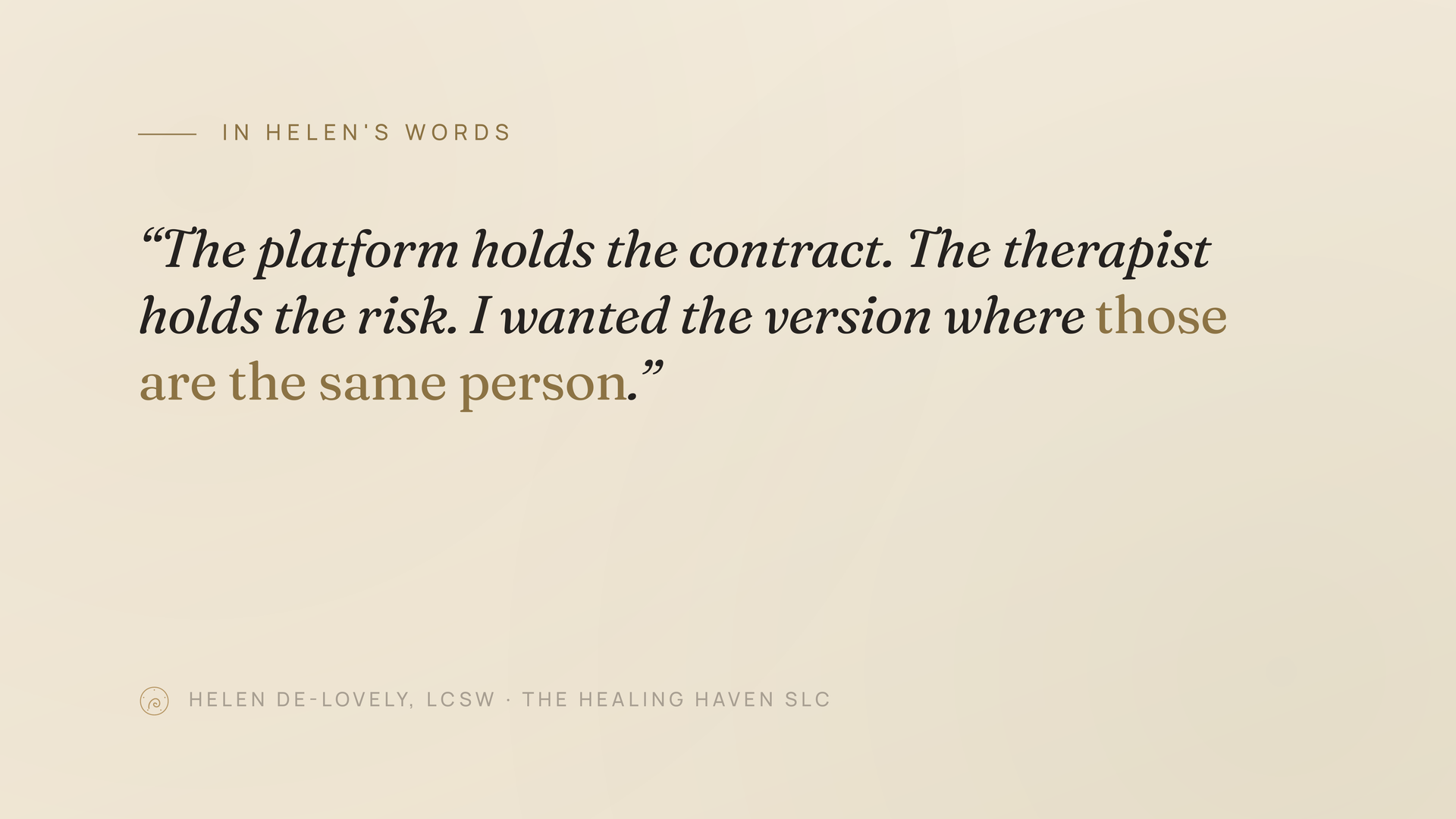
In Helen's words: "The platform holds the contract. The therapist holds the risk. I wanted the version where those are the same person."
The Healing Haven SLC is located at 250 E 200 S, Suite 1521, Salt Lake City, UT 84111. Reach me at (385) 443-4045 or [email protected].
Book a free 15-minute consult →
Frequently Asked Questions
Is Alma or Headway better for therapists?
They're structurally similar: both hold the insurance contracts and sit between the therapist and the payer. The better question is whether a platform-held contract fits your practice at all. For some therapists it does; for mine, it doesn't.
Do Alma and Headway pay therapists less than direct contracts?
It depends on the payer and the market. What's documented is that platform-contracted therapists have absorbed unilateral rate cuts — Headway's Optum cuts in January 2025 and Aetna's Alma-specific changes in July 2026 — that did not apply to directly contracted clinicians in the same networks.
Does The Healing Haven take insurance?
Not in-network yet — we're in the middle of direct credentialing with insurance payers. Today we're out-of-network: $189 per session, memberships from $123, and superbills for plans with out-of-network benefits. Book a free consult and we'll walk through your specific plan together.
Why not just join a platform now and credential directly later?
Because the in-network status typically belongs to the platform, not the therapist. Building on their contract now doesn't shorten the direct path later — and it hands the middle of every client relationship to a third company in the meantime.
I'm a therapist in Utah considering these platforms. Should I?
That's genuinely your call — the trade-offs are real on both sides. My only advice: before you sign, read who holds the contract, who absorbs clawbacks, and what happens to your caseload's in-network status if you leave. Decide with those answers in front of you.
This article reflects my professional opinion and experience as a private practice owner, alongside publicly reported information about third-party platforms, current as of July 2026. It is general information, not medical, legal, billing, or financial advice, and does not establish a therapeutic relationship. Alma and Headway are trademarks of their respective companies; The Healing Haven is not affiliated with either. If you are in crisis, call or text the 988 Suicide & Crisis Lifeline. If you are in immediate danger, call 911.
Sources
ClearHealthCosts. "2 digital mental health platforms cut pay rates for therapists with UnitedHealth's Optum, stirring anger." clearhealthcosts.com
Behavioral Health Business. "[UPDATED] Aetna Cuts Rates with Alma-Contracted Therapists." bhbusiness.com
PsiAN. "Aetna, Alma, and Spring Health Reimbursement Changes: What Therapists Need to Know." psian.org
Mental Wealth Solutions. "Headway and Alma Therapist Pay Cuts of Up to 30%."mentalwealthsolutions.org
ClearHealthCosts. "Therapists have misgivings on the platforms: Alma, Headway etc. and the business of therapy." clearhealthcosts.com