
Focus and Function: A Nutrition-First Routine for Distractible Days
By Helen De-Lovely, LCSW — The Healing Haven SLC
Most advice about focus starts with the calendar — a better planner, a stricter schedule, more willpower. It rarely starts with the body. But the kind of focus that actually holds up through a long, demanding day has less to do with discipline than with whether your nervous system has the raw materials it needs to sustain it.
This is a plain-language look at what's on the Focus and Function shelf here at the practice — part of a small, curated set of supplements I offer clients through Thorne, a practitioner-grade supplement brand used by tens of thousands of health professionals. It's general information, not a personalized recommendation. That conversation happens one-on-one.
Key Takeaways
Focus and follow-through are partly nutritional, not purely a matter of willpower — a well-resourced nervous system makes consistency easier to sustain.
The Focus and Function shelf is part of The Healing Haven's Wellness Shelf, sourced through Thorne.
These are structure/function supports, not a treatment for any diagnosis, and not a substitute for therapy, medication, or medical care.
L-theanine, magnesium, and a few foundational nutrients are the usual starting point — not a "stack," and not all at once.
If you take prescription medication, especially stimulants, SSRIs, or MAOIs, talk to your prescriber before adding anything new. A few of these interact.
This article is general information. It's not medical advice.
In This Article
Why focus is a body problem, not just a discipline problem
What's on the Focus and Function shelf
Start with calm, not stimulation
What the research actually says
Building a routine, not a stack
Questions worth asking first
How this fits at The Healing Haven
Frequently asked questions
Why Focus Is a Body Problem, Not Just a Discipline Problem
Attention isn't a fixed trait you either have or don't. It's a state — and states are resourced by things like sleep, hydration, blood sugar, and how activated or depleted your nervous system is at a given moment. A perfectly good system — a planner, a routine, a checklist — can still fail on a day your body doesn't have the resources to run it.
That's the idea behind the Wellness Shelf generally, and the Focus and Function shelf specifically: instead of starting with more structure, start with whether your body has what it needs to hold structure at all.
What's on the Focus and Function Shelf
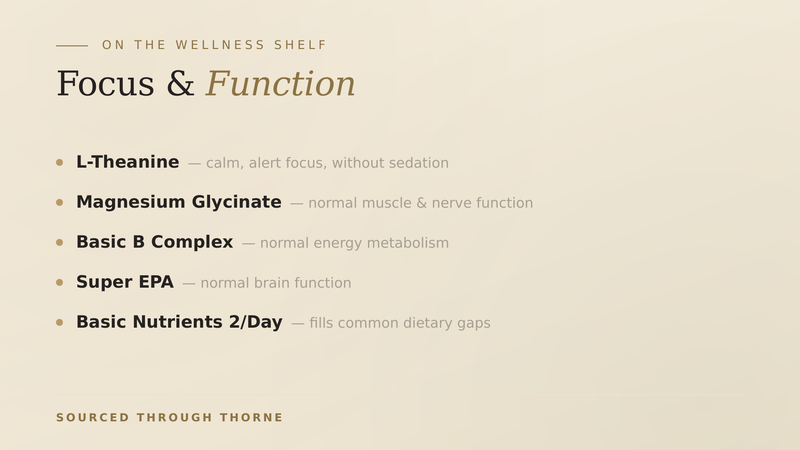
A few ingredients make up most of what I point clients toward here, all sourced through Thorne:
L-Theanine— An amino acid found naturally in tea. Research has looked at its role in supporting a calm, alert state without drowsiness.
Magnesium Glycinate— A highly absorbable form of magnesium, a mineral involved in normal muscle and nerve function. Most adults don't get enough magnesium from food alone.
Basic B Complex— B vitamins support the body's normal energy metabolism — useful foundational support for anyone running on empty by mid-afternoon.
Super EPA (concentrated omega-3)— Supports normal brain function as part of an overall balanced diet.
Basic Nutrients 2/Day— A foundational multivitamin/mineral formula that fills common dietary gaps rather than targeting any one thing.
None of these are stimulants. None of them are marketed — by Thorne or by this practice — as a treatment for any diagnosis. They're foundational nutritional support, full stop.
Start With Calm, Not Stimulation
The most common mistake is starting with whatever sounds most "activating" — something marketed for energy or drive. In practice, that tends to backfire if your system is already running hot. If you're wired, tense, or running on stress hormones by mid-morning, adding more stimulation on top rarely produces the steady, sustained focus people are actually looking for.
That's why L-theanine and magnesium are usually the starting point, not an afterthought. The goal isn't to push harder. It's to lower the background noise enough that whatever structure you build on top of it actually has a chance to hold.
What the Research Actually Says
It's worth being honest about the state of the evidence here, because overpromising is exactly what gives supplements a bad name.
L-theanine research is genuinely interesting but still developing. A randomized, placebo-controlled crossover study of 34 healthy adults found that an L-theanine drink reduced subjective stress response to a cognitive stressor, along with a drop in stress-hormone response several hours later.1That's a real finding — and also a small study. Broader reviews note that evidence for many of L-theanine's popular claims remains limited, with a real need for more rigorous human trials.
Magnesium's role in nerve and muscle function is well-established nutritional science, backed by decades of research compiled by the NIH's Office of Dietary Supplements.2What's less certain is how much a given person's day-to-day focus improves from supplementing it — that depends heavily on whether you were running low to begin with.
None of this is a promise of a specific result. It's an honest starting point for a conversation.
Building a Routine, Not a Stack
One more thing worth saying plainly: this isn't a "focus stack" you start all at once on a Monday. The advice I give clients is the same advice that shows up in the safety literature on combining supplements generally — introduce one new thing at a time, give it several days, and pay attention to how your body actually responds before adding the next one. If something's going to disagree with you, you want to know which ingredient did it.
Consistency, applied gently over weeks, does more than intensity applied for three days and abandoned.
Questions Worth Asking First
Before adding anything new to your routine, it's worth pausing on a few questions — the same ones I ask before pointing anyone toward the Wellness Shelf:
Are you pregnant, breastfeeding, or trying to conceive?
Do you take any prescription medication — especially stimulants, SSRIs, MAOIs, or blood thinners? Several Wellness Shelf ingredients can interact with these.
Do you have any kidney, liver, thyroid, or bleeding-related conditions?
Do you have an upcoming surgery?
Have you had a bad reaction to a supplement before?
If you answered yes to any of these, loop in your prescribing physician before starting anything new. This isn't caution for its own sake — some of these interactions are serious, and the responsible move is always to coordinate, not guess.
How This Fits at The Healing Haven
The Wellness Shelf isn't a storefront — it's part of a broader conversation I have with clients about what their nervous system needs to support the work we're doing together. If you're curious whether any of this fits your routine, it's worth bringing up at your next appointment, or in a free consult if you're not yet a client.
In Helen's words:"Most of my clients don't need a better system. They need a nervous system that has what it takes to hold whatever system they choose. That's the whole idea behind the Wellness Shelf — start with the body, then build structure on top of it, not the other way around."
The Healing Haven SLC is located at 250 E 200 S, Suite 1521, Salt Lake City, UT 84111. Reach me at (385) 443-4045 or [email protected].
Schedule a free 15-minute consult— it's a conversation, not a commitment.
Frequently Asked Questions
Do I need a diagnosis to try anything on the Focus and Function shelf?
No. These are general wellness supports, not a treatment tied to any diagnosis.
Are these a replacement for therapy or medication?
No. They're a nutritional foundation that can sit alongside therapy, medication, or neither — not a substitute for either.
Where do these products come from?
Everything on the Wellness Shelf is sourced through Thorne, a practitioner-grade supplement brand used by health professionals nationally. Ask Helen directly for current sourcing and ordering details.
Is this medical advice?
No. This article is general information for educational purposes. Talk to your prescribing physician before starting any new supplement, especially if you take medication.
What if I'm already taking something similar?
Bring your current supplement list to your next appointment or consult so it can be part of the conversation.
This article is for general informational purposes only and is not medical advice. These statements have not been evaluated by the Food and Drug Administration. These products are not intended to diagnose, treat, cure, or prevent any disease. Always talk to your prescribing physician before starting a new supplement, particularly if you take stimulant medication, SSRIs, MAOIs, or blood thinners. This post does not establish a therapeutic relationship. If you are in crisis, please contact the 988 Suicide & Crisis Lifeline by calling or texting 988.
Sources
White, D. J., et al. "Anti-Stress, Behavioural and Magnetoencephalography Effects of an L-Theanine-Based Nutrient Drink: A Randomised, Double-Blind, Placebo-Controlled, Crossover Trial." National Library of Medicine (PMC).pmc.ncbi.nlm.nih.gov/articles/PMC4728665
Office of Dietary Supplements, National Institutes of Health. "Magnesium – Consumer."ods.od.nih.gov/factsheets/Magnesium-Consumer