What Is a Neurodivergent-Affirming Therapist? (And Why I Became One)
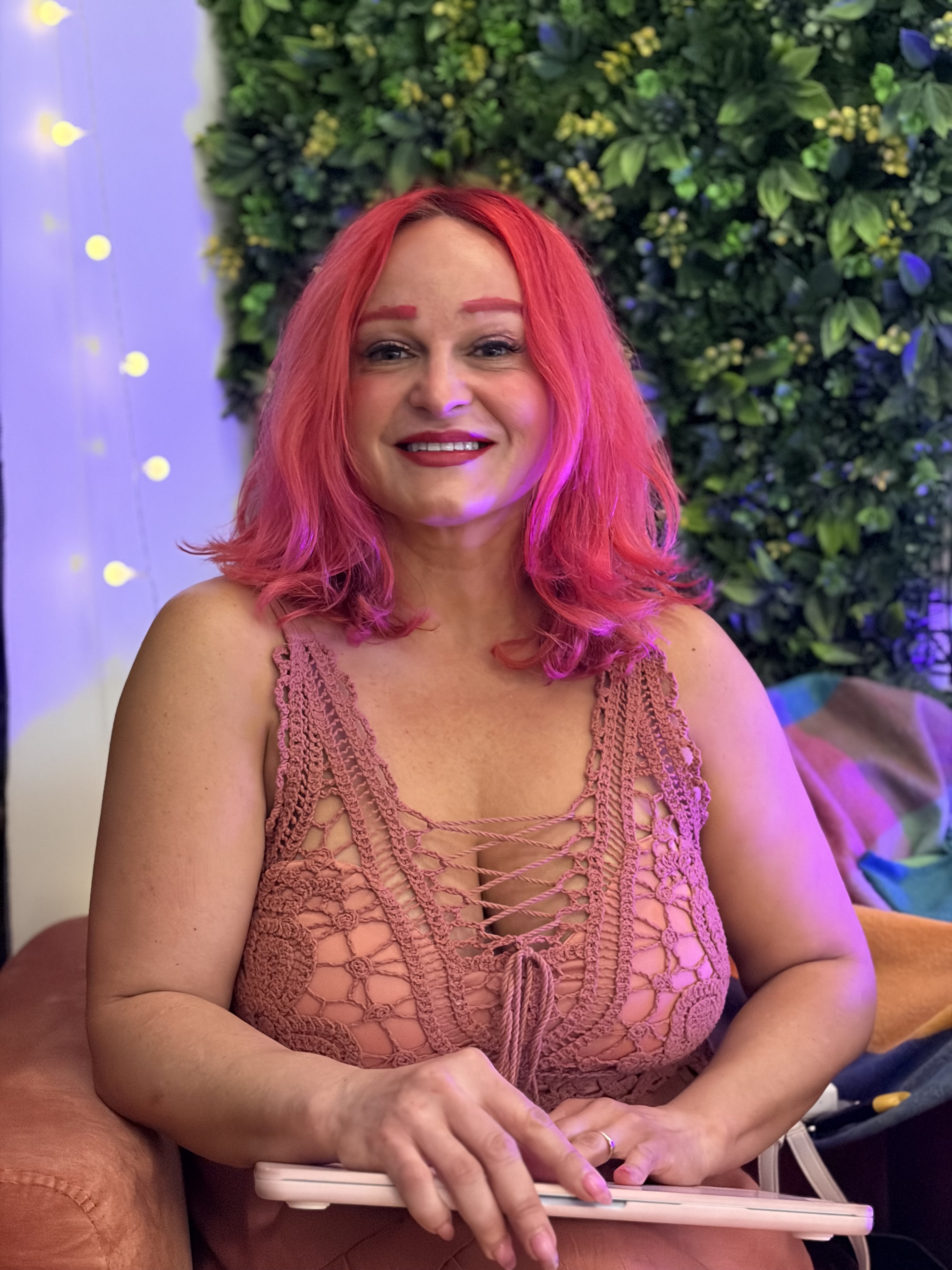
By Helen De-Lovely, LCSW — The Healing Haven SLC
I was diagnosed with ADHD at 22.
Before that, I spent two years in residential treatment being treated for the wrong thing. So when I tell you what a neurodivergent-affirming therapist is, I'm not going to start with a framework or a definition from a textbook. I'm going to start with what it feels like when you don't have one — because I've lived both sides of this room.
If you found this page by searching "neurodivergent affirming therapist Salt Lake City" at some strange hour, wondering whether therapy could actually feel different this time — this one's for you.
Key Takeaways
- A neurodivergent-affirming therapist starts from the premise that your brain is a variation, not a defect — nothing about you needs to be "fixed" into looking neurotypical.
- Affirming care changes real things: the pacing, the goals, the structure of sessions, and whether masking is treated as a skill or a cost.
- I was diagnosed with ADHD as an adult, after years of being misread — that experience shapes how I practice today.
- You do not need a formal diagnosis, or any label at all, to work with an affirming therapist.
- The Healing Haven SLC sees adults in person in downtown Salt Lake City and online across Utah. The first step is a free 15-minute consult: helendelovely.com/consult.
In This Article
- Diagnosed at 22: my story
- What "neurodivergent-affirming" actually means
- Affirming vs. traditional therapy — what actually changes
- What sessions actually look like here
- Signs affirming care might fit
- The whole person (not just the checklist)
- A success story
- How to start in Salt Lake City
- Frequently asked questions
Diagnosed at 22: My Story
People ask me sometimes how getting an ADHD diagnosis as an adult is different from getting one as a kid. It's very different. Here's how I said it on our podcast:
"Being diagnosed when you're an adult is much different, because you have basically been gaslit. All the times you were told you were too much — or 'what's wrong with you,' or 'why don't you remember things.' We didn't get the support. And so we had so much shame."
By the time anyone said the letters A-D-H-D to me, I had already been through the system — the hard way.
"I was in residential treatment for two years, and I had depression — but basically it was ADHD and trauma. It was not bipolar. It was not BPD. It was not some attachment disorder. It was a neurological difference."
Two years. And the thing that was actually going on was a difference in how my brain is wired, colliding with a world that had no idea what it was looking at.
Even after the diagnosis, the help mostly wasn't there:
"There still weren't practitioners or therapists that knew how to deal with ADHD. It's like — okay, you have this, but I don't really know how to help your brain. Or, I don't really understand how it really feels for you. The rejection sensitivity, and the extreme emotions, and feeling really lonely."
What finally shifted things for me wasn't a treatment plan. It was understanding. I picked up a book about ADHD and creative minds and — I'll just tell you the way it happened:
"It was insane, because I read it in one night, and I've never done that, ever, with a book. And then I'm like — there's nothing wrong with me, actually."
There's nothing wrong with me, actually. That sentence is the whole reason this blog post exists. It's the sentence I want you to walk out of my office with — in your own words, in your own time.
What "Neurodivergent-Affirming" Actually Means
"Affirming" gets used loosely, so let me be specific about how I use it.
A neurodivergent-affirming therapist works from the understanding that human brains vary — attention, sensory processing, communication style, time perception, emotional intensity — and that this variation is part of human diversity, not a pile of defects to correct. ADHD, autism, AuDHD, and every combination and question mark in between.
Here's the way I put it to my own clients:
"I tell my clients it's not even a disability — because if the world was different, it wouldn't be considered a disability."
That's not me minimizing how hard it can be. Executive function struggles are real. Burnout is real. Rejection sensitivity can flatten your whole week. What I'm saying is that the pain mostly comes from the collision between your wiring and a world built for someone else's — and therapy should be one place where that collision stops.
Affirming care is also trauma-informed care, because most neurodivergent adults arrive carrying years of being misread. My rule for the room is the same one I hold for all trauma work:
"There can be no judgment. And the person explaining the experience is correct in their perception."
You don't have to prove your experience to me. You don't have to bring documentation. If you say the fluorescent lights at work wreck you by 2 p.m., I believe you.
Affirming vs. Traditional Therapy — What Actually Changes
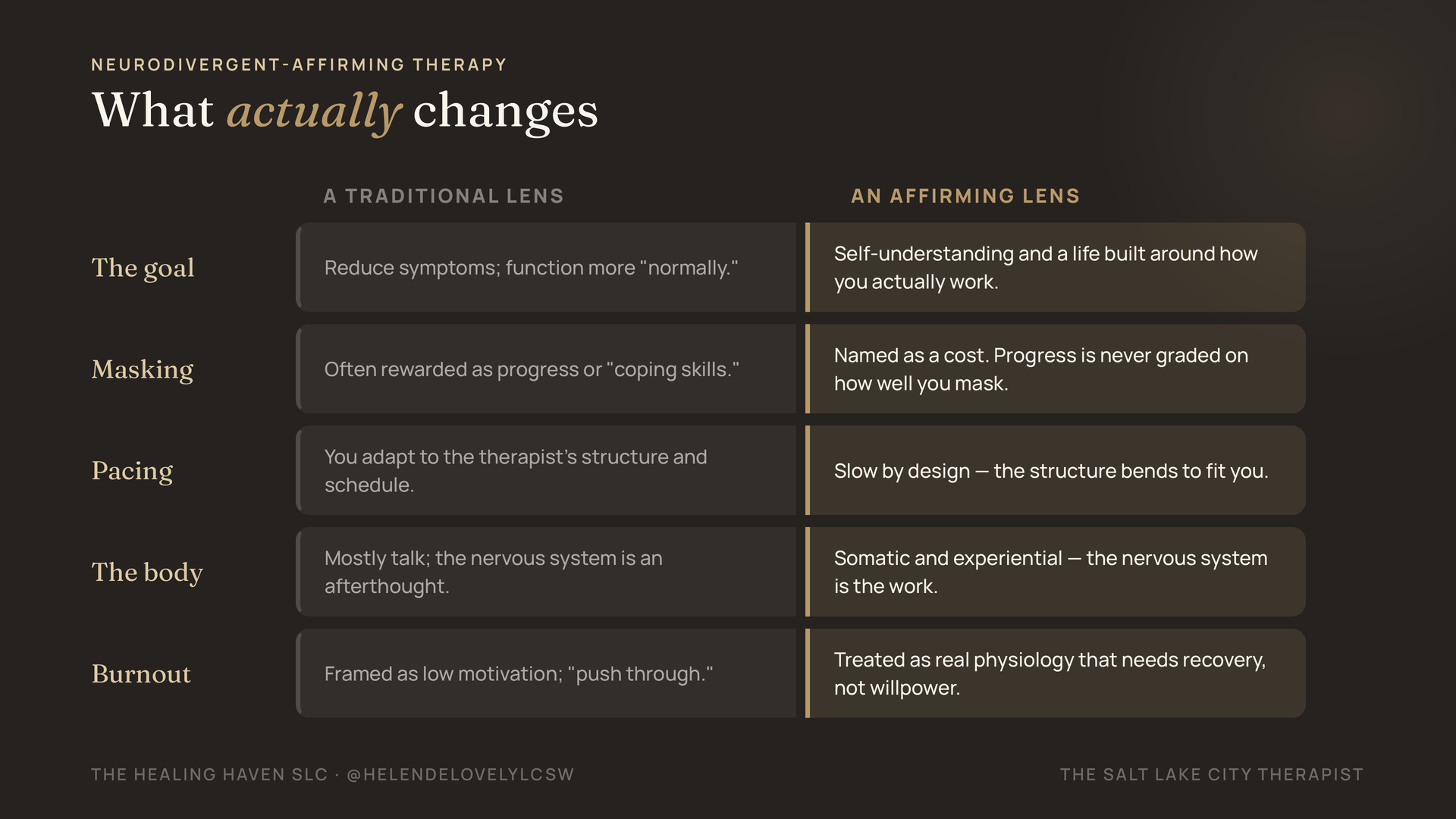
A lot of traditional therapy was built and tested around neurotypical brains. It isn't malicious — but applied without modification, it can quietly become one more place you're asked to try harder to be someone else. Here's what actually changes in an affirming room:
The goal changes. The target is not "look more normal." It's self-understanding, a calmer nervous system, and a life built around how you actually function.
Masking is treated as a cost, not a skill. If you've spent years suppressing your natural way of moving, talking, and thinking to seem fine, you already know how expensive that is. I will never grade your progress by how well you mask.
The structure bends to you. Need to fidget, stand up, take the long way around to a point, sit in silence for a minute? That's not off-task behavior. That is the session.
Burnout is treated as real. ADHD burnout and autistic burnout are physiological states, not motivation problems. "Push through" is not a treatment plan.
Advocacy is part of the work. This one I care about a lot, because the stigma is still everywhere:
"There's still so much stigma with ADHD. Even my clients who are struggling in school — it still is a push for me to encourage them to get accommodations. And even when they do get accommodations, it's hard for them to verbalize that those accommodations need to be enforced."
Part of my job is helping you find the words to ask for what you're entitled to — at school, at work, in doctors' offices — and to stop apologizing for needing it.
What Sessions Actually Look Like Here
The Healing Haven is slow by design. We move at the speed of safety, and the work isn't held to a stopwatch. That's not a slogan — it comes straight out of my own experience of what didn't work:
"My treatment has always been experiential, because that's the only way I've been able to really learn things — through experience. Plus, with my ADHD and not wanting to sit still, it helps me focus."
So no, you will not be sitting perfectly still on a couch reciting your week while I nod. Sessions here are somatic and experiential — we work with your nervous system, not just your thoughts. Sometimes that's EMDR for the old stuff that still stings. Sometimes it's breath work, movement, sound, or a grounding visualization. Sometimes it's simpler than that:
"A lot of times we just need another person to breathe with us — to slow us down."
And once you have your footing, you drive:
"I will ask them: so what do you want to do today? What do you want to work on today?"
If you don't like somatic work, we don't do somatic work. You never have to earn flexibility here by proving the standard way failed first.
I'll also share what works on my own nervous system, because I use these tools too:
"I like to regulate my nervous system by walking in nature. At the beginning of the trail my brain is like — she did this, or he did that, or I didn't do that right. Just monkey mind. By the end of my time, my brain is quiet. I feel so much better. I feel calmer — and regulated, if you will."
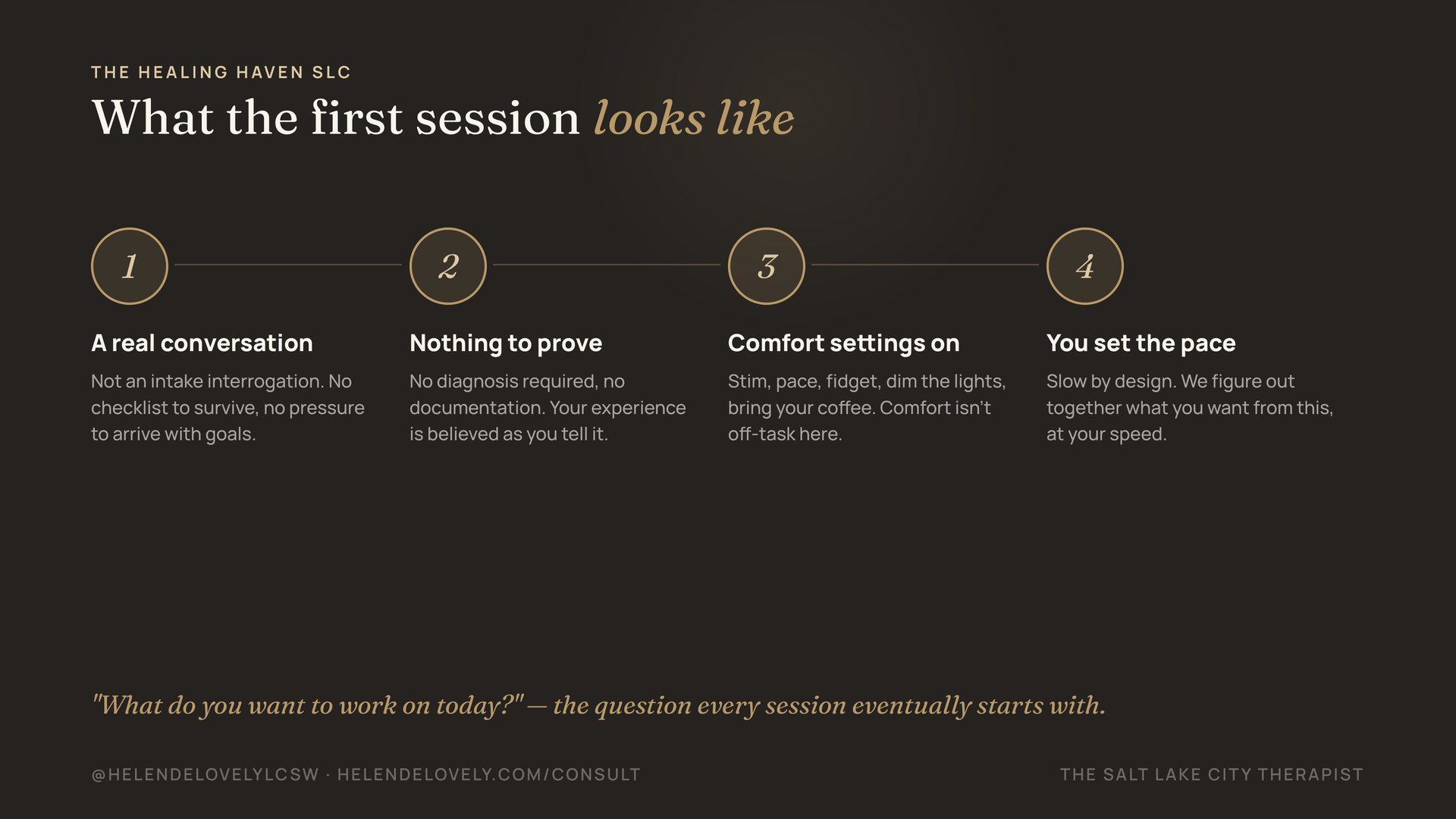
Your first session is a conversation, not an intake interrogation. No checklist to survive, no pressure to arrive with goals. Come as you are — stim, pace, bring your coffee, keep your sunglasses on if the light is a lot. We'll figure out together what you want from this, at whatever speed that takes.
Signs Affirming Care Might Fit
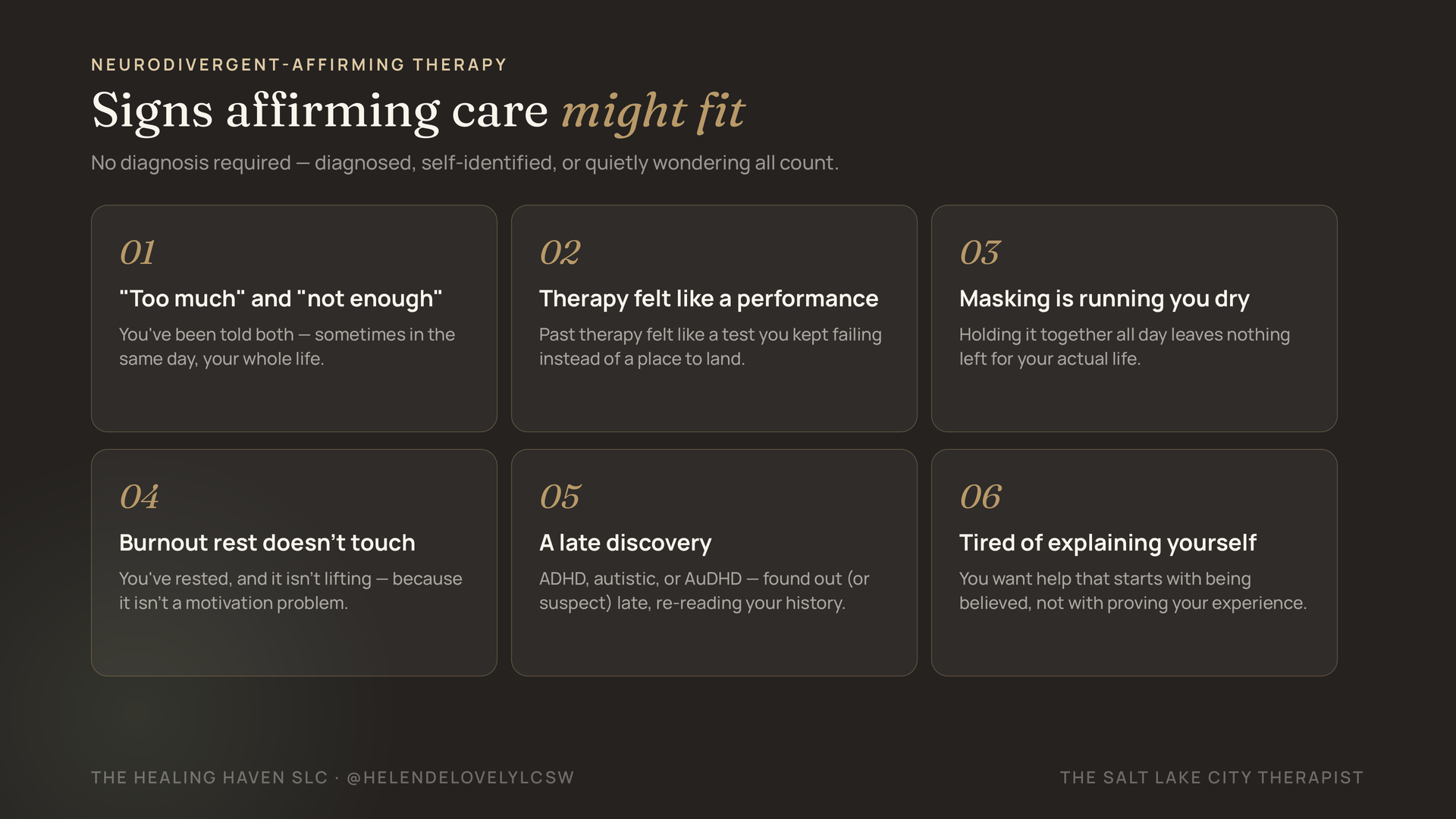
You don't need a diagnosis to be here. Diagnosed at 8, diagnosed at 48, self-identified, or just quietly wondering — all of it counts. Affirming care might be a fit if:
- You've spent your life being told you're "too much" or "not enough" — sometimes both, in the same day.
- Previous therapy felt like a performance you kept failing.
- Masking gets you through the day and leaves nothing for your actual life.
- You're in a burnout that rest doesn't seem to touch.
- You found out (or suspect) late that you're ADHD, autistic, or AuDHD, and you're re-reading your whole history with new eyes.
- You are so, so tired of explaining yourself before you can even get to the part where you get help.
If a few of those landed, that's information worth taking seriously.
The Whole Person (Not Just the Checklist)
One more thing that makes affirming care different: your brain doesn't live in a jar. It lives in a body, with sleep and hormones and food and dopamine, inside a life.
Some of the most honest conversations at my practice are about exactly that intersection — like how ADHD and food can tangle together, because of the dopamine we genuinely do get from eating, and how much shame people carry about it without anyone ever explaining the mechanism. Naming that out loud, without judgment, changes things for people. (To be clear: anything involving medication — for attention, weight, hormones, any of it — is a decision that belongs with you and a prescriber. That's their lane, and I respect it.)
What I can do is make the medical side less scary. Getting assessed and finding the right support as a neurodivergent adult can be genuinely nerve-wracking — walking into an appointment, being doubted, trying to describe your inner world to a stranger with a clipboard. I've been through it myself, and I prepare my clients for it:
"I would help them — this is what you say, this is how you explain your symptoms — because the whole process is incredibly nerve-wracking. And because I've been through it myself."
You don't have to navigate any of it alone. That's the point of this whole practice.
A Success Story
On our first podcast episode, talking about the clients I get to work with now, I said something I don't say lightly:
"You're going to see a success story. I am one too. I was in foster care."
I don't share that for sympathy. I share it because it's the ground I stand on when I tell you that people are not broken. I was a kid the system misread at every turn — foster care, then residential treatment for conditions I didn't have — and I'm now a licensed clinical social worker with a practice full of people I genuinely love working with. Not because someone fixed me. Because eventually I got what everyone deserves from the start: someone who saw what was actually there.
That's what I'm offering you. Not a cure, not a transformation program. Being seen accurately, maybe for the first time — and building from there.
Ask a Therapist: "We are gentle beings. There's no reason to be rough, or to help us get used to living in fight or flight. How does that help us?"
How to Start in Salt Lake City
I'm Helen De-Lovely, LCSW. I see adults at The Healing Haven SLC — in person in downtown Salt Lake City (250 E 200 S, Suite 1521) and online anywhere in Utah, Monday through Thursday by appointment.
I built this practice on purpose for a specific person:
"The Healing Haven is really designed for that client that's been looking forever — that knows what they want, and knows how they need to feel in order to heal."
If that's you, the first step is small: a free 15-minute consult. No commitment, no intake-forms ambush, just a conversation to see if we fit — because fit matters more in this work than almost anything else.
Book a free 15-minute consult →
Rates and coverage, plainly: sessions are $189 private-pay. The Healing Group Membership is $29/month and brings the session rate down to $123, plus group sessions and community — month-to-month, cancel anytime. It's not insurance. Utah Medicaid is accepted directly after verification, and I provide superbills for out-of-network commercial insurance benefits.
Frequently Asked Questions
Do I need a diagnosis to see a neurodivergent-affirming therapist?
No. Self-identified, still exploring, formally diagnosed, or just sure that standard approaches haven't fit — you're welcome here exactly as you are. A diagnosis is never a ticket you have to show at the door.
How is neurodivergent-affirming therapy different from regular therapy?
The starting premise. Traditional approaches can quietly aim you at looking more neurotypical; affirming therapy aims at self-understanding, nervous-system regulation, and a life built around how you actually work. The pacing, goals, and structure all follow from that.
I've had bad experiences in therapy before. Will that be a problem?
The opposite — it's useful information, and I'd genuinely like to hear about it. Many neurodivergent adults have been talked over, pathologized, or graded on masking in previous therapy. Naming that is often where the real work starts.
Do you work with ADHD, autism, and AuDHD?
Yes — adults with ADHD, autistic adults (including late-identified), AuDHD, and people who don't claim any label but recognize themselves in this post. I also bring my own lived experience of adult ADHD diagnosis to the work.
Can I do sessions online?
Yes. I see clients in person in downtown Salt Lake City and by telehealth across Utah, Monday–Thursday.
What does it cost, and do you take insurance?
$189 per session private-pay, or $123 for Healing Group members ($29/month). Utah Medicaid is accepted after verification. For commercial insurance I'm out-of-network and provide superbills you can submit for possible reimbursement. Bring your questions to the free consult — we'll sort the money part out plainly before you commit to anything.
You're invited: The Grand Opening
Before you go — come meet the practice in person. We're celebrating with an open house: food, tours of the space, and a chance to put a face to everything you just read.

Register for the Grand Opening → — September 18, 5–7pm, Hyatt Regency Salt Lake City.
This post is for general educational and informational purposes only. It is not a substitute for professional mental health assessment, diagnosis, or treatment, and reading it does not establish a therapist–client relationship. If you are in crisis, call or text 988 (Suicide & Crisis Lifeline) or go to your nearest emergency room.