
We Watched a Clearinghouse Keynote Like It Was the Super Bowl
There are two Zacks in this story, and I should sort them out before anything else.
One is Zack Scriven, my partner and our Practice Growth Director, who was sitting next to me on the couch. The other is Zack Kanter, the founder and CEO of a company called Stedi, who was on the TV. We took a picture with him. He does not know this.
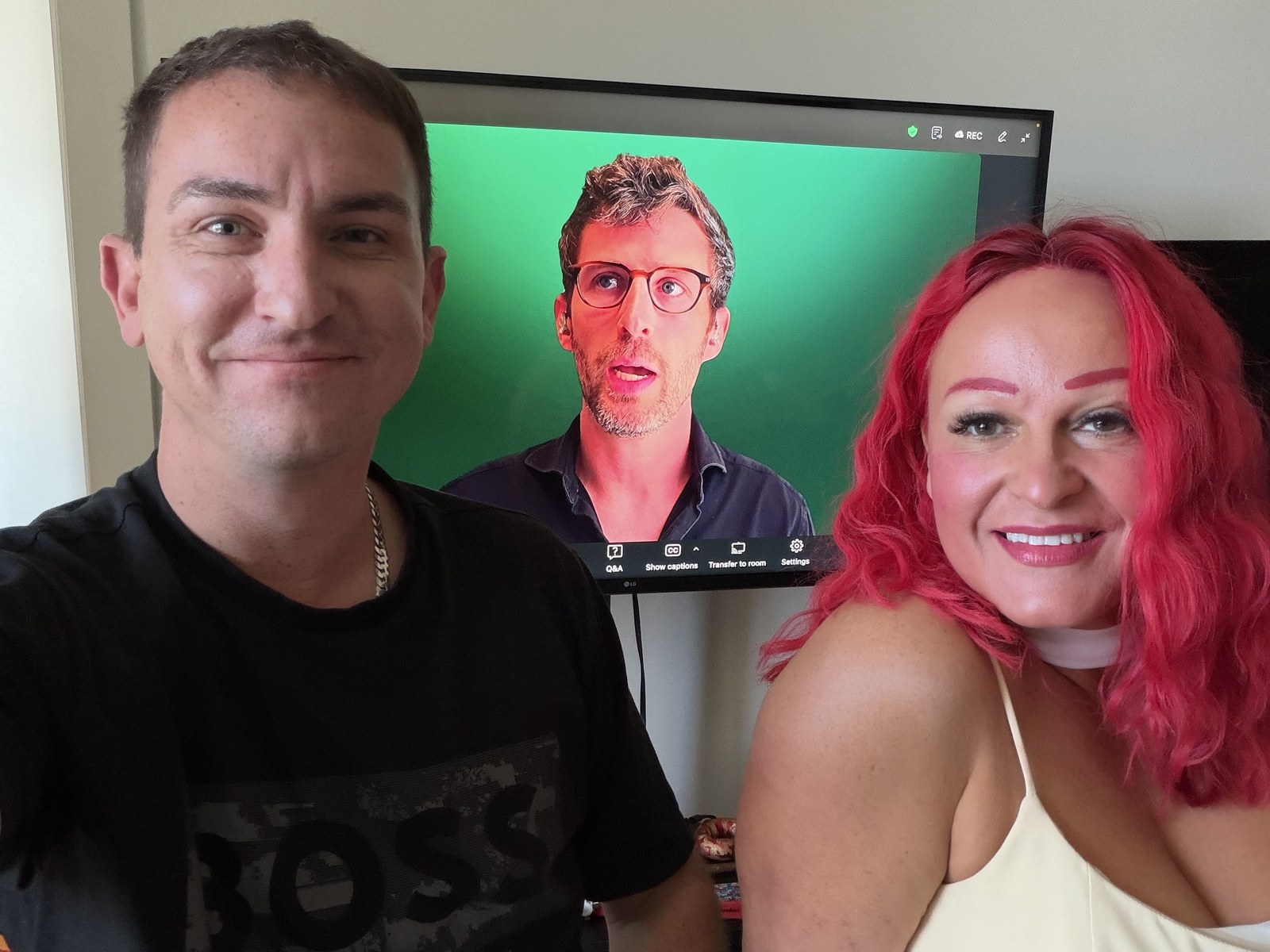
This was the first Stedi Keynote — their first-ever user event — and it was virtual, which is why it happened in our living room. About a hundred and thirty people were in the webinar. At some point during the live Q&A I typed something into the question box that I want to put here in full, because it's the most honest sentence in this post and I wrote it before I knew it would get read out loud:
My partner Zack says Stedi is one of the most incredible technology platforms he's ever worked with. Kudos. What you have done is nothing short of incredible.

It got answered live. I made a small noise.
I'm putting the screenshots in this post on purpose. A hundred and twenty-seven people watched a healthcare company's first keynote from wherever they were, and I don't think anybody else is going to document what it looked like from a therapist's living room. So: here is what it looked like.
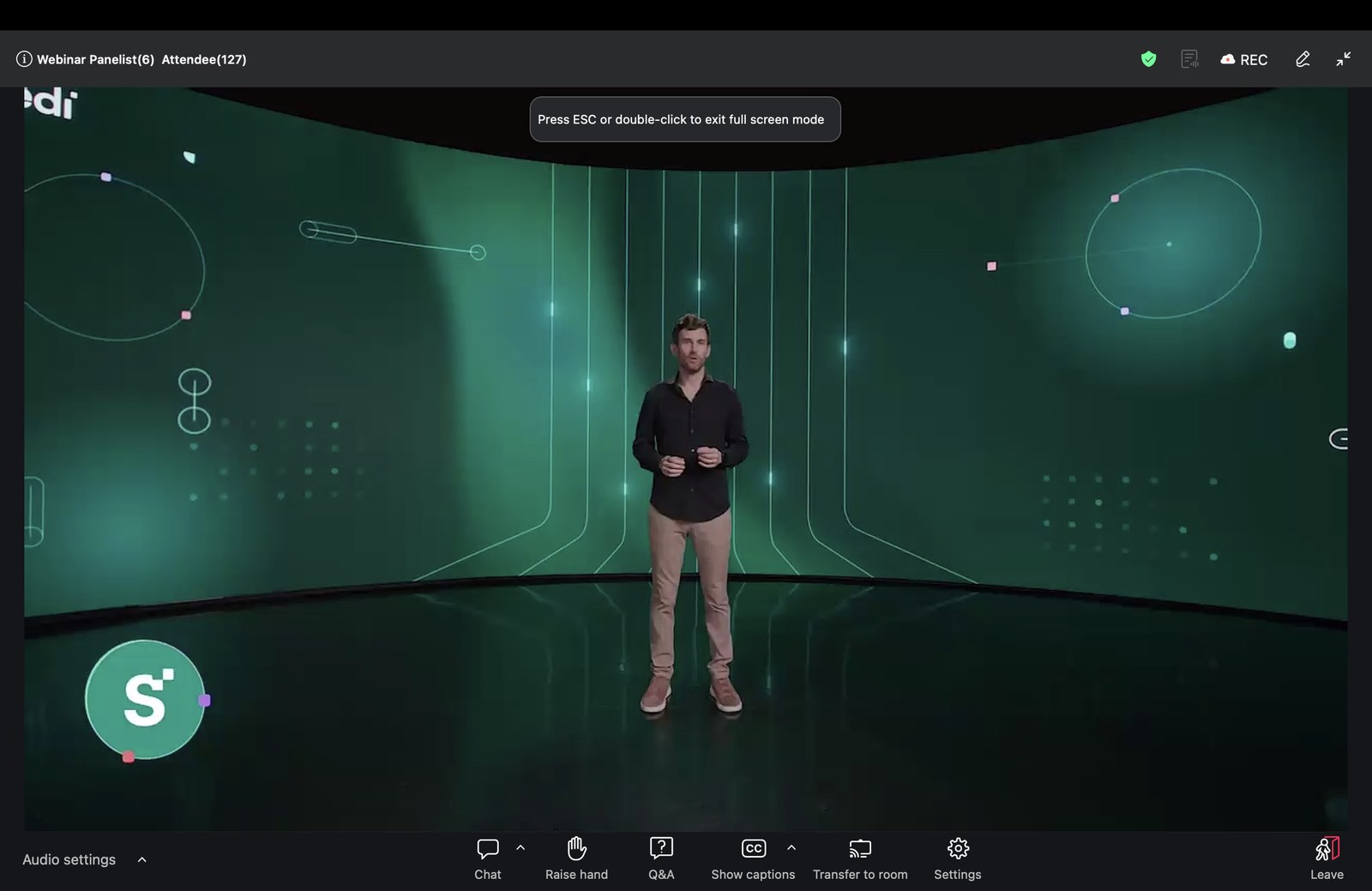
Then I sat there for a while thinking about how strange it is that a trauma therapist in Salt Lake City just cheered, out loud, for a healthcare clearinghouse. And I decided that strangeness is the actual subject of this post.
What a clearinghouse is, and why you've never had to know
If you've been in therapy, you've used one. You just never saw it.
When a therapist "takes your insurance," what actually happens is that after your session, a claim has to travel from her office to your insurance company in a very specific electronic format that was designed a long time ago and has not gotten friendlier since. A clearinghouse is the company in the middle that carries it. It also carries the answer back — whether the claim was accepted, what got paid, what got denied — and, before any of that, it carries the eligibility check: the question of whether your coverage is active and what it does.
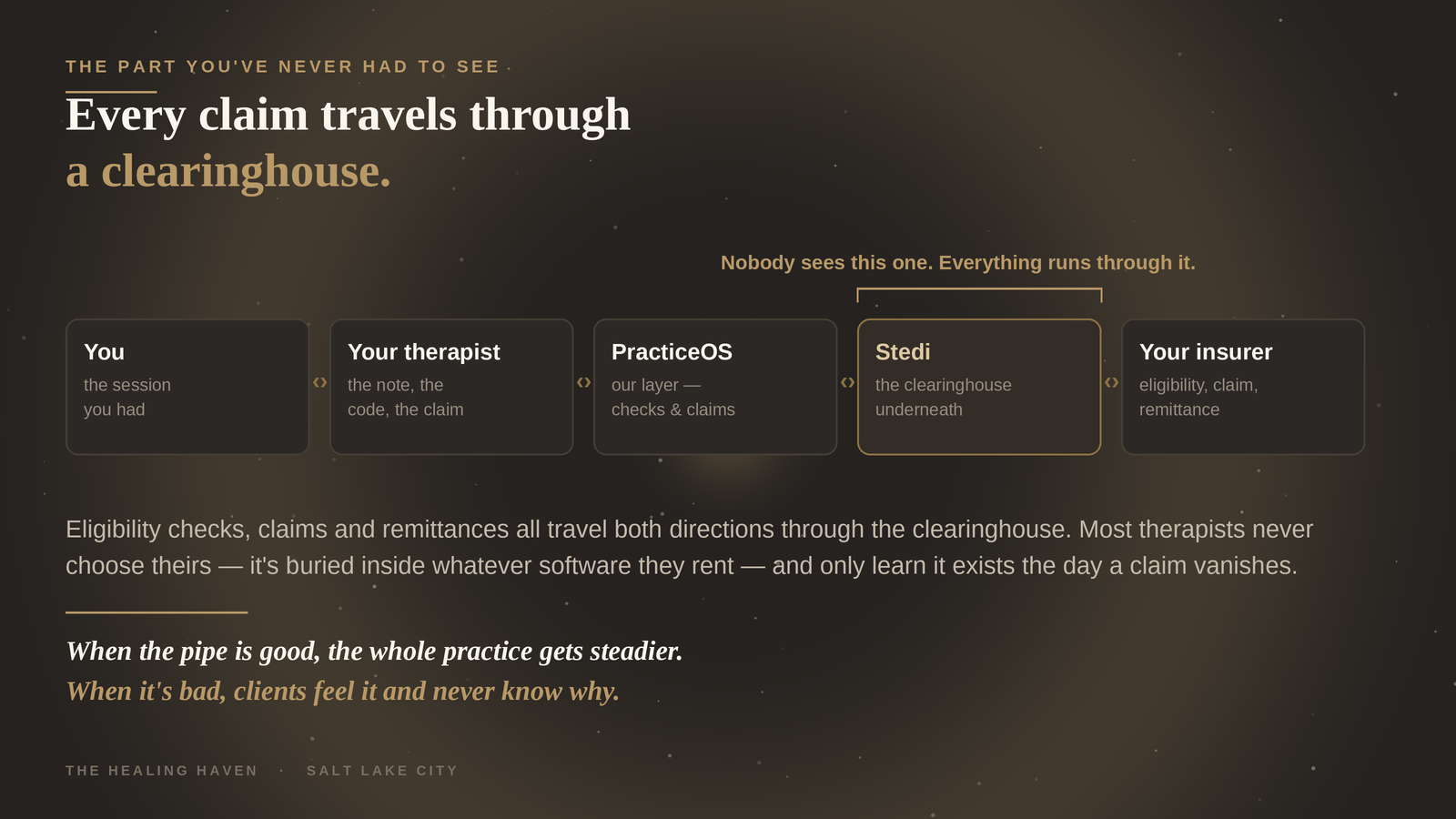
Every eligibility check, every claim, every remittance. All of it goes through one of these. Most therapists never think about which one, because it's buried inside whatever practice-management software they rent, and they only find out it exists on the day a claim vanishes.
I wrote two weeks ago about a conference full of hospital executives describing how care gets lost upstream — at credentialing, at the eligibility check, at the front desk. The clearinghouse is the pipe all of that upstream work runs through. So when the pipe is good, the whole practice gets steadier. When the pipe is bad, the clients feel it and never know why.
Why the price was the whole story for us
Here's the part that mattered most to my practice, and it isn't a feature. It's a number.
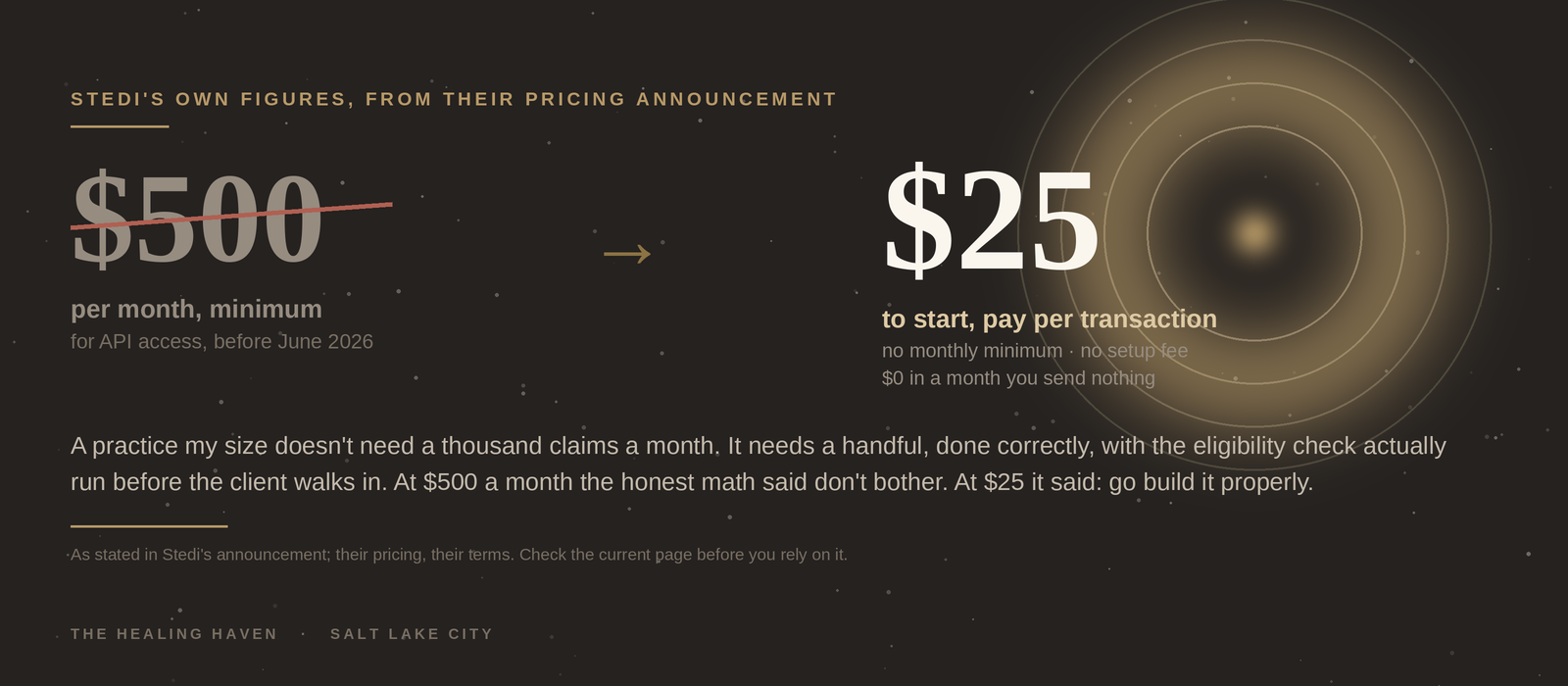
Until this June, getting real programmatic access to Stedi meant a $500-a-month minimum. That's their figure, from their own announcement, and they were candid about who it priced out: startups, small practices, solo developers. In other words, us.
Then they introduced pay-as-you-go. You fund a small starting balance — it now starts at $25 — and you pay per transaction, with no monthly minimum and no setup fee. If you send nothing in a month, you pay nothing.
I want to be precise about what that changed, because "cheaper" undersells it.
A practice my size doesn't need a thousand claims a month. It needs a handful of claims a month, done correctly, with the eligibility check actually run before the client walks in. On a $500 minimum, the honest math says don't bother — keep renting somebody else's pipe and live with whatever it does. On pay-as-you-go, the math says: go build it properly.
So we did. We got our account set up, worked through enrollment with Utah Medicaid, and we're now submitting real claims to Utah Medicaid through Stedi. This morning, before the keynote even started, Zack ran an eligibility check on our entire Medicaid client roster in one batch. The responses came back with things I've historically had to chase by phone — active coverage, managed-care assignment, provider restrictions, even the address the state has on file.
And I'll say the unfinished part out loud, since that's how I do these posts: two of our transaction enrollments with Medicaid — the ones for electronic eligibility and for electronic remittance — were still showing as provisioning this week even after claims went live. That's the normal lag of a payer enrollment, not a Stedi problem, and it didn't stop the checks from working. But it's the truth of where we are on September 9th.
Small budget. Real claims. That is not a sentence I could have written in March.
What they announced
I'm going to keep this short, because Stedi wrote their own recap and it's better than mine would be. Everything below is as they presented it; we haven't tested most of it yet.
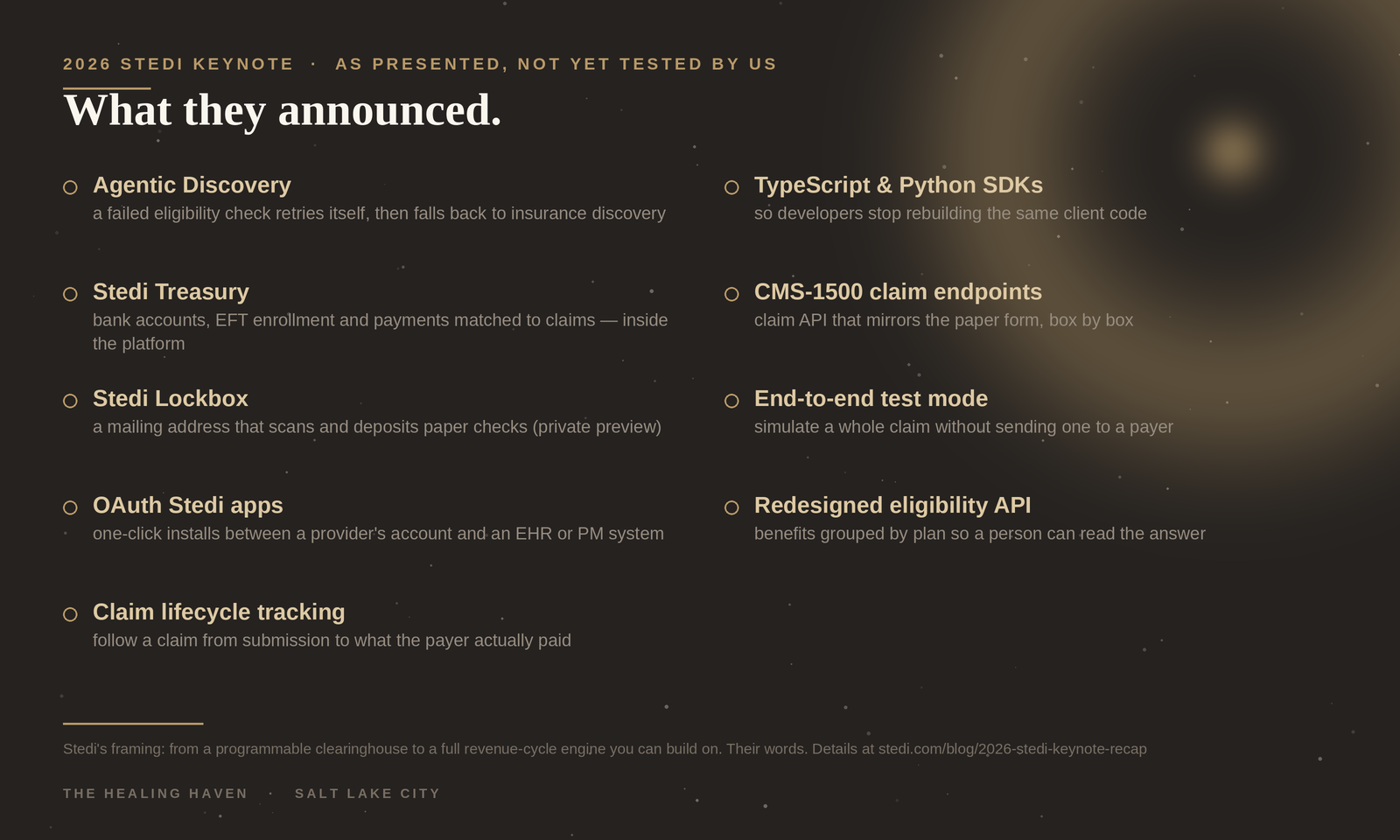
The headline, in their own framing, was a shift from being a clearinghouse to being a full revenue-cycle engine you can build on. The pieces: an AI-assisted eligibility flow that retries a failed check and falls back to insurance discovery; bank accounts and EFT enrollment inside the platform (Treasury); a mailing address that scans and deposits paper checks (Lockbox, in preview); one-click app installs; tracking a claim from submission to what the payer actually paid; official software kits so developers stop rebuilding the same plumbing; claim endpoints that mirror the paper CMS-1500 form box by box; a proper test mode; and a redesigned eligibility response that groups benefits by plan so you can read it.

Zack was practically vibrating during the SDK segment. I was somewhere else entirely.
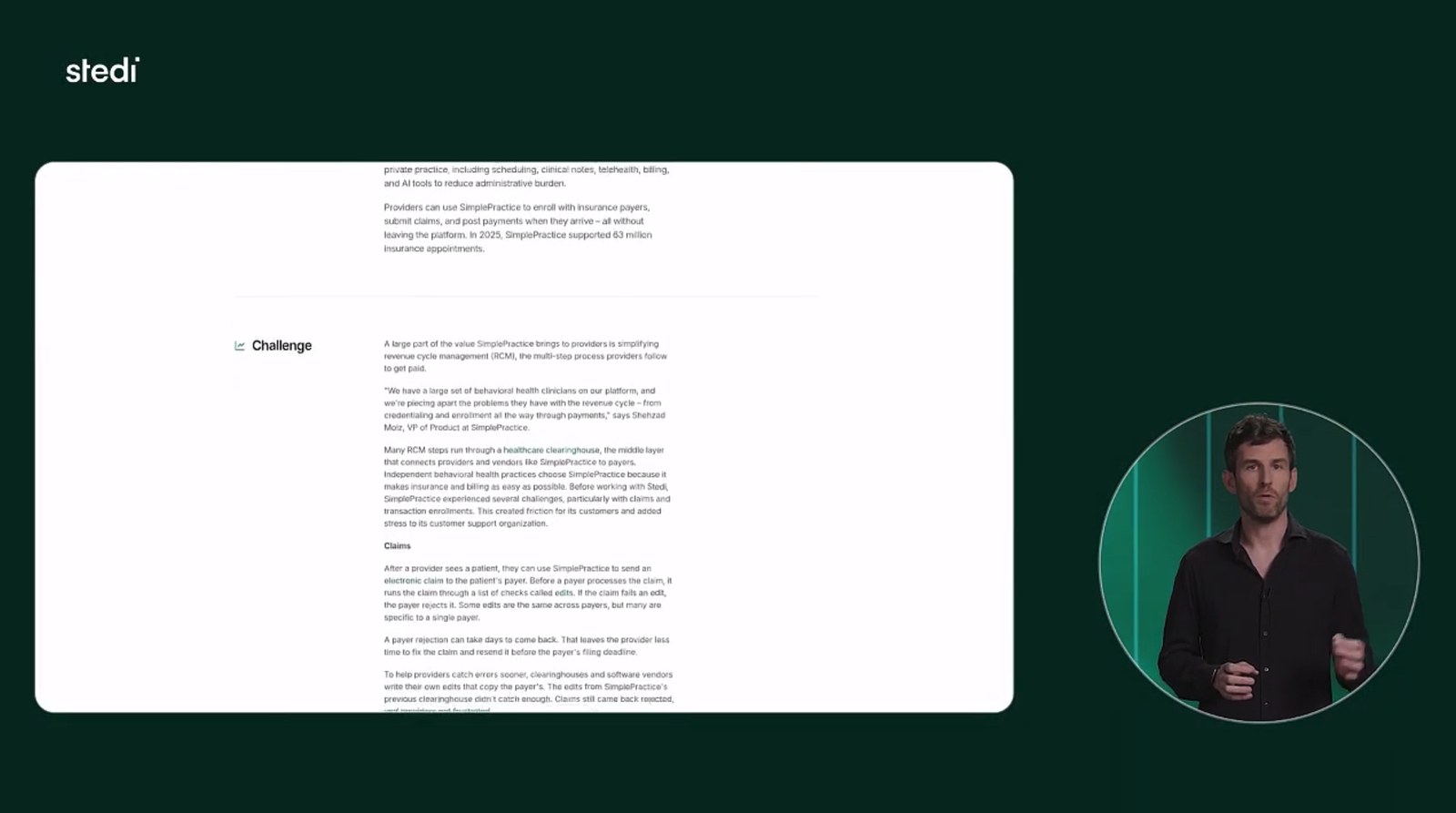
They also walked through a case study with SimplePractice — a platform a lot of therapists reading this will recognize, because it's probably the one you rent — about the claim rejections and enrollment friction that pushed them to switch clearinghouses. I sat there thinking: that's the bundled pipe I described above, and even the bundle has a pipe under it.

The Slack channel that was open the whole time
Here's the detail I most want other practice owners to hear, because it's the part that isn't about software.
Stedi gave us a shared Slack channel. Not a support ticket queue — a channel, with nineteen people from their side in it. While the keynote was playing, that channel was open on Zack's laptop, and we were reacting in it in real time like we were texting friends during a game.
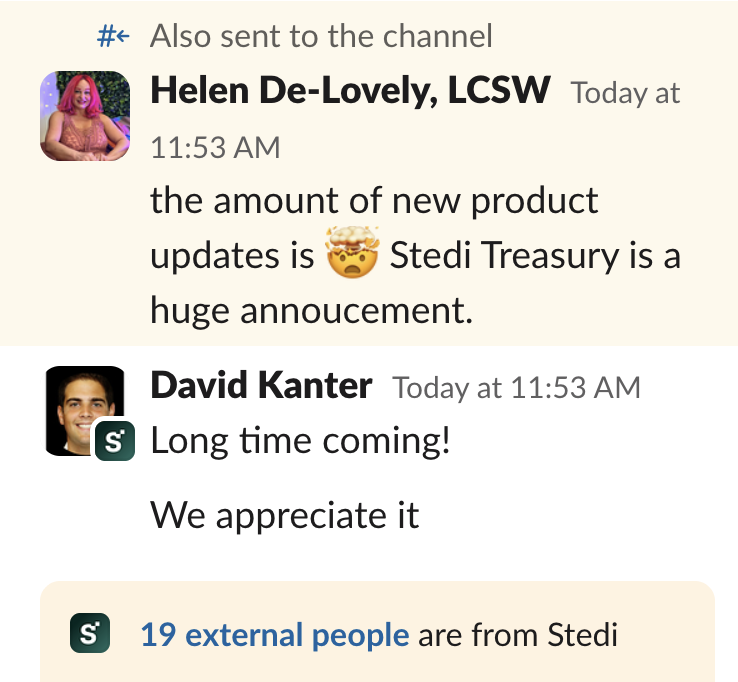
I typed that Treasury was a huge announcement. Someone at Stedi wrote back within the minute: long time coming, we appreciate it.
I've been a clinician for a long time, and I want to say plainly what that felt like: it felt like being seen. Healthcare professionals — especially the ones running small practices — spend most of their vendor relationships on hold, in a portal, or reading a canned reply. A company that puts its own people in a room with a five-person practice and answers a therapist's excited message like it matters is doing something most of this industry has decided isn't worth the cost.
It is worth the cost. It's the whole reason I'm writing a blog post about a clearinghouse instead of quietly renewing a subscription.
The one that made me sit up
It was Treasury.
Here's the thing a small practice owner will recognize instantly and everyone else will find dull: I have never, in my career, been able to look at a deposit and know which session it paid for.
Money arrives from a payer. It's a lump. Somewhere there's a remittance document that explains the lump, and somewhere else there's the claim the remittance is about, and connecting those three things is a spreadsheet, a Sunday, and a headache. Multiply by every payer. This is the part of running a practice that nobody warns you about in graduate school.
What Stedi described — as they described it, we don't have it turned on yet — is payments landing in an account in the practice's name, then being matched automatically to the remittance and the claim, so you can follow one session all the way from submitted to paid out without matching anything by hand.
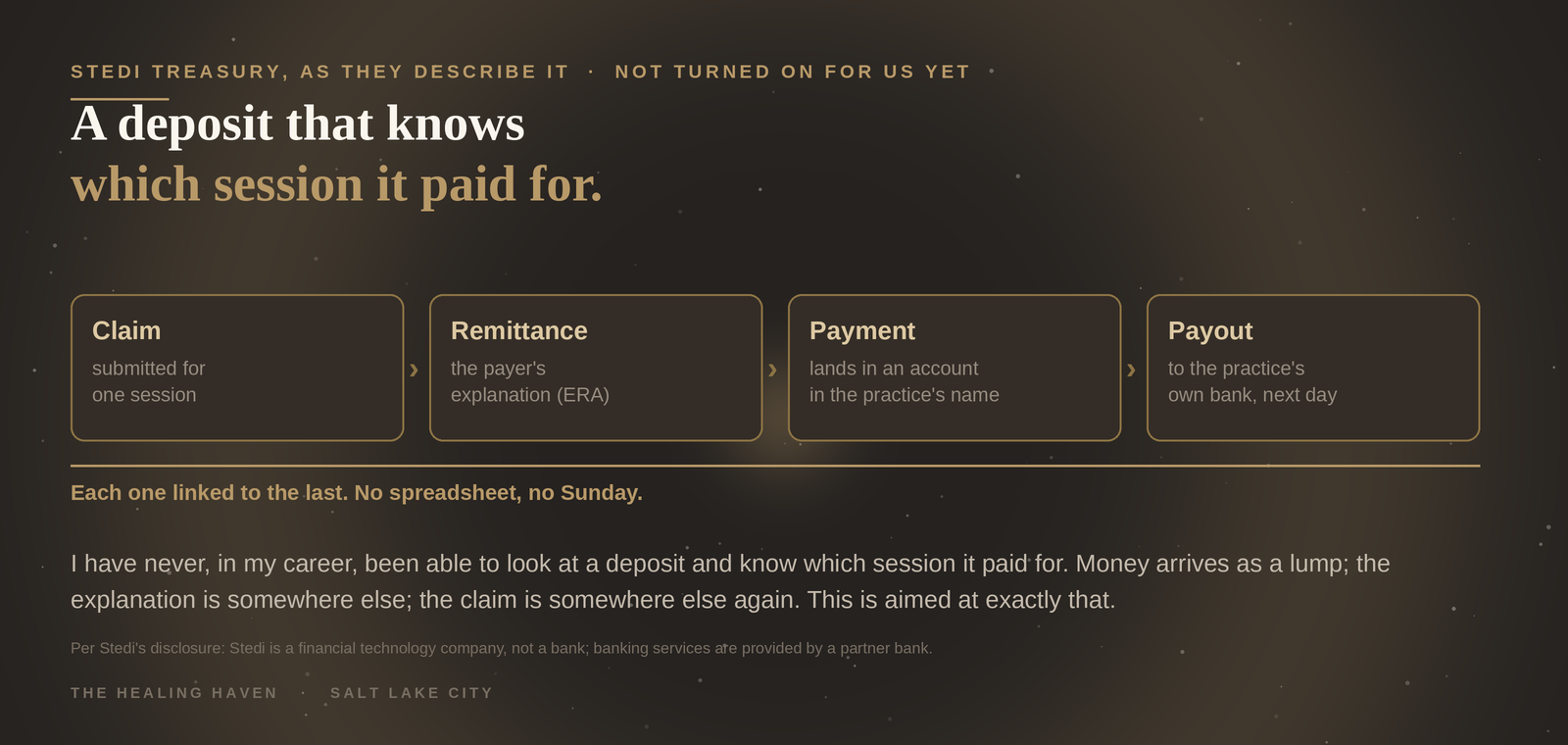
I don't know yet how well it works. I'll tell you when I do. But I know what it's for, because I've lived the problem it's aimed at, and it's the first time I've heard a company describe that problem back to me the way I'd describe it to a colleague.
What we've already done about it
This is the part I'm proud of, and it's small.
Zack and I decided months ago that The Healing Haven shouldn't be a practice that rents its plumbing. We're building our own operating layer — we call it PracticeOS — and The Healing Haven is its founding practice, which means everything gets built here first and proven on real clients, real payers and real deadlines. Sonja Scriven, our Group Practice Manager, is the product manager, because she's the one who lives inside the daily operations all of this lands on.
Stedi is what runs underneath it. Every eligibility check and every claim in PracticeOS goes through their pipe.
And because we knew roughly where they were heading, we'd already started restructuring how we store things to be ready. Insurance policies now live as their own record instead of a few fields on a client's profile, so one person can have a primary plan, a secondary plan, and a policyholder who isn't them. We added the demographic and policyholder fields a professional claim actually requires. We attached the diagnosis to the client's episode of care rather than to the person, which is the thing a claim needs and the thing a person shouldn't be reduced to.
None of that is glamorous. All of it is what has to be true before a payment can be matched back to a session, and a session back to a person, without a human doing the matching. When Treasury turns on for us, we'd like to be ready for it rather than surprised by it.
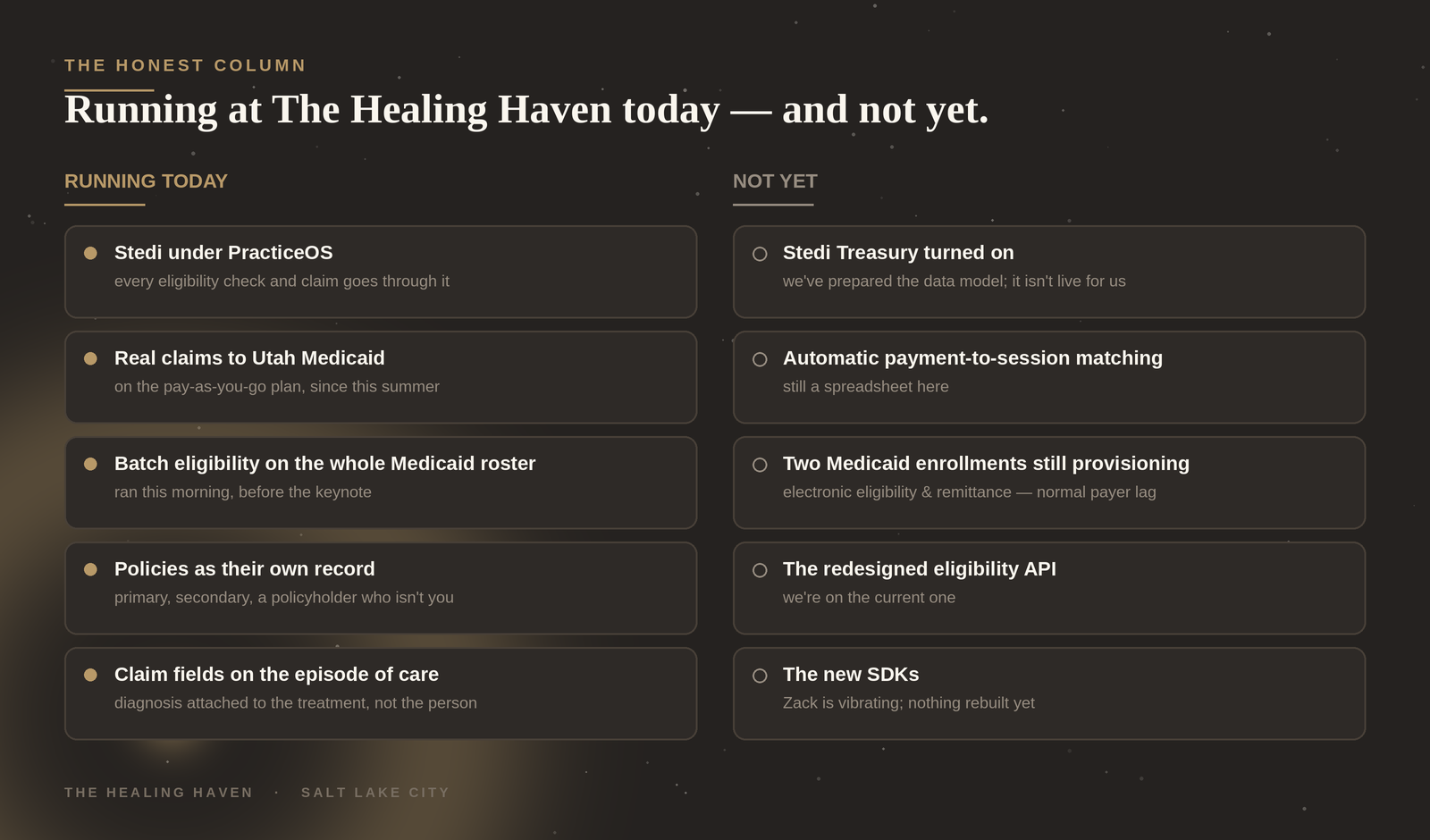
I'd rather show you the right-hand column than let you think we're further along than we are.
Why any of this makes us different
Most therapy practices — good ones, run by people I respect — rent every part of their administrative life from one vendor. Scheduling, notes, billing, the clearinghouse underneath, all bundled. The vendor decides what the eligibility check looks like. The vendor decides whether it gets re-run. The vendor decides what you can see about a denied claim and when.
I'm not saying that's wrong. For most practices it's the sane choice. It just means the thing that decides whether you find out about a coverage problem before or after your session isn't the therapist. It's a product roadmap somewhere in another state.
We chose the harder version. We own the layer between you and the insurance machine, and we chose the best pipe we could find to put under it. Your coverage gets checked before anything is scheduled, and re-checked as we go. And when something in the insurance layer goes wrong — because it will — the person answering for it is me, by name, with a license. Not a support ticket.
If you want to see it in person: September 18
Twenty years ago I had my own practice, didn't have the support I needed, and had to close it. This time it took under six months to get running — and the difference wasn't that I got better at therapy. It was that I finally understood the business underneath it, and had people and tools that took the administrative weight off.
That is exactly what PracticeCon is for. Friday, September 18, at the Hyatt Regency Salt Lake City, from 8am: a one-day conference for Utah therapists on the business side of running a practice. Six live CEUs and lunch for $97, which is not an accident given Utah's September 30 CEU deadline. Zack and I will be there, and the stuff in this post — the plumbing, the pricing, what to build versus what to rent — is the kind of thing we'll be talking about out loud, with other practice owners in the room.
And then, same day, same building, 5 to 7pm, we're keeping the room and throwing The Healing Event — the first annual. Flowers, cake, a somatic session and a sound bath with me, in the Park City Room on the 3rd floor. It's for clients, past clients, and the wider Healing Haven circle. Twenty-five spots. It's a celebration, not a pitch.
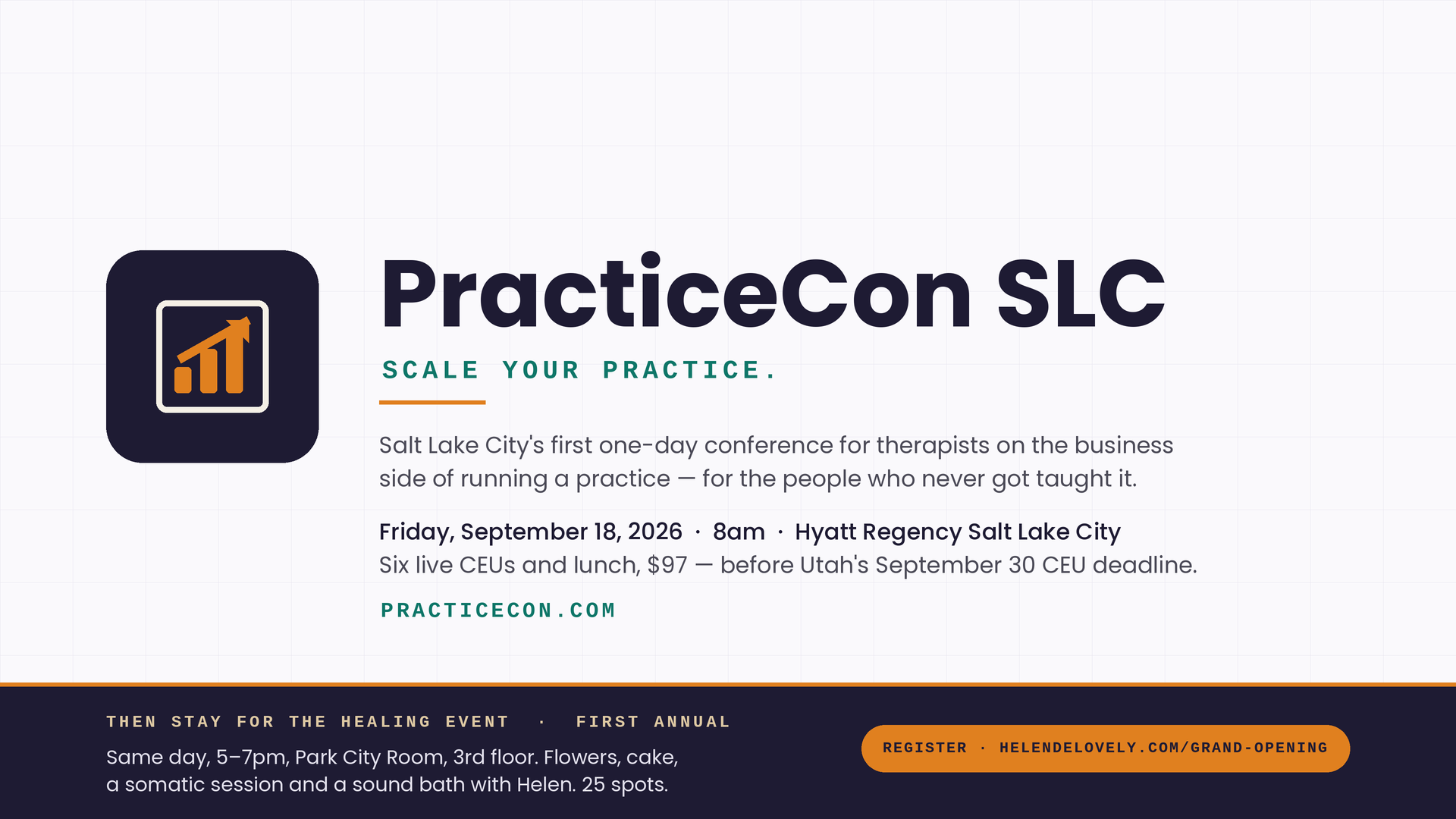
Register for The Healing Event here — it's free, and I'd love to see your face.
Two Zacks
I want to close on the couch.
Next year's keynote, they said, will be in person. I'm going. I want to shake the hand of the Zack who was on the TV and tell him, without a question box in between, what his company let a practice my size do this year. Then I'll come home to the Zack who was on the couch, who took a $500-a-month problem and turned it into a $25 one, and who is building the rest of this with me.
A therapist cheering for a clearinghouse. I've made peace with it.
Come see what we're building. PracticeCon in the morning, The Healing Event at five. September 18. I'll save you a piece of cake.
Helen De-Lovely, LCSW, is the founder of The Healing Haven in Salt Lake City — the founding practice of PracticeOS — where she works with clients on trauma, adult ADHD, and nervous-system healing through EMDR and somatic approaches. Zack Scriven is Practice Growth Director; Sonja Scriven is Group Practice Manager and product manager for PracticeOS. The Healing Haven is a paying Stedi customer on their pay-as-you-go plan; this post was not sponsored, requested, or reviewed by Stedi, and Stedi does not endorse The Healing Haven or PracticeOS. Features described above are as presented at the 2026 Stedi Keynote and in Stedi's own materials, and have not been independently tested by The Healing Haven unless stated. Per Stedi's disclosure, Stedi is a financial technology company, not a bank; banking services for Stedi Treasury are provided by a partner bank. The Slack exchange pictured is from a shared vendor channel and is reproduced with the practice's own message; Stedi's reply is quoted as it appeared. Nothing here is a prediction about any individual insurance plan.