
Where Care Actually Gets Lost
A healthcare company mailed us a mocktail kit.
That's how it started. Tuesday, September 1st. A box showed up at the practice — bottles, a printed recipe card, the whole thing — because Medallion's Elevate conference was virtual, and somebody in their marketing department understood that if you're going to ask people to sit through eight hours of panels about medical billing, you should probably send them something to hold.
I laughed at it. Then I made one, because it was that kind of week, and I sat down for the whole day. (We made a little video about the kit, if you want to see it.)
I should say up front that we're customers of theirs — our credentialing profiles live in Medallion, which I wrote about last week — so you can take my warmth about the free mocktail with however much salt that deserves.
I want to be honest about what I expected. I expected to be annoyed.
Last week I wrote about credentialing — the six-month paperwork process that decides whether a therapist can bill your insurance, and why the wait to see one has almost nothing to do with how badly you need help. I ended that post by saying the story of what my team built to get around it was a story for another day. I figured that day was months off.
Instead it showed up on a Tuesday, in a box, with a mocktail in it.
Why I thought this wasn't my conversation
Zack Scriven, our Practice Growth Director, sat in with me. This is the kind of room where the people who run revenue operations for hospital systems and multi-state provider groups talk to each other more or less honestly, because they're all facing the same machine.
Not a therapy conference. Not a small-practice conference. Nobody in that room has my problems. They have compliance departments. They have people whose entire job is one insurance company.
I have a practice in Salt Lake City where, for a long stretch, the person whose entire job was the insurance companies was me, at 9pm, after the last session.
So my expectation going in was the usual one: big-system people solving big-system problems with big-system money, and the translation down to a practice my size would be zero.
I lasted about twenty minutes before I put the glass down and started taking notes.
Because they weren't describing a different problem. They were describing mine, at a scale where somebody had finally bothered to measure it. Some of it was just good general education for anyone running a practice. Some of it landed much closer to home than I expected for someone doing mental health work specifically.
The thing almost every one of them said
The panels were about getting paid. Specifically, about what it costs an organization when a claim comes back denied.
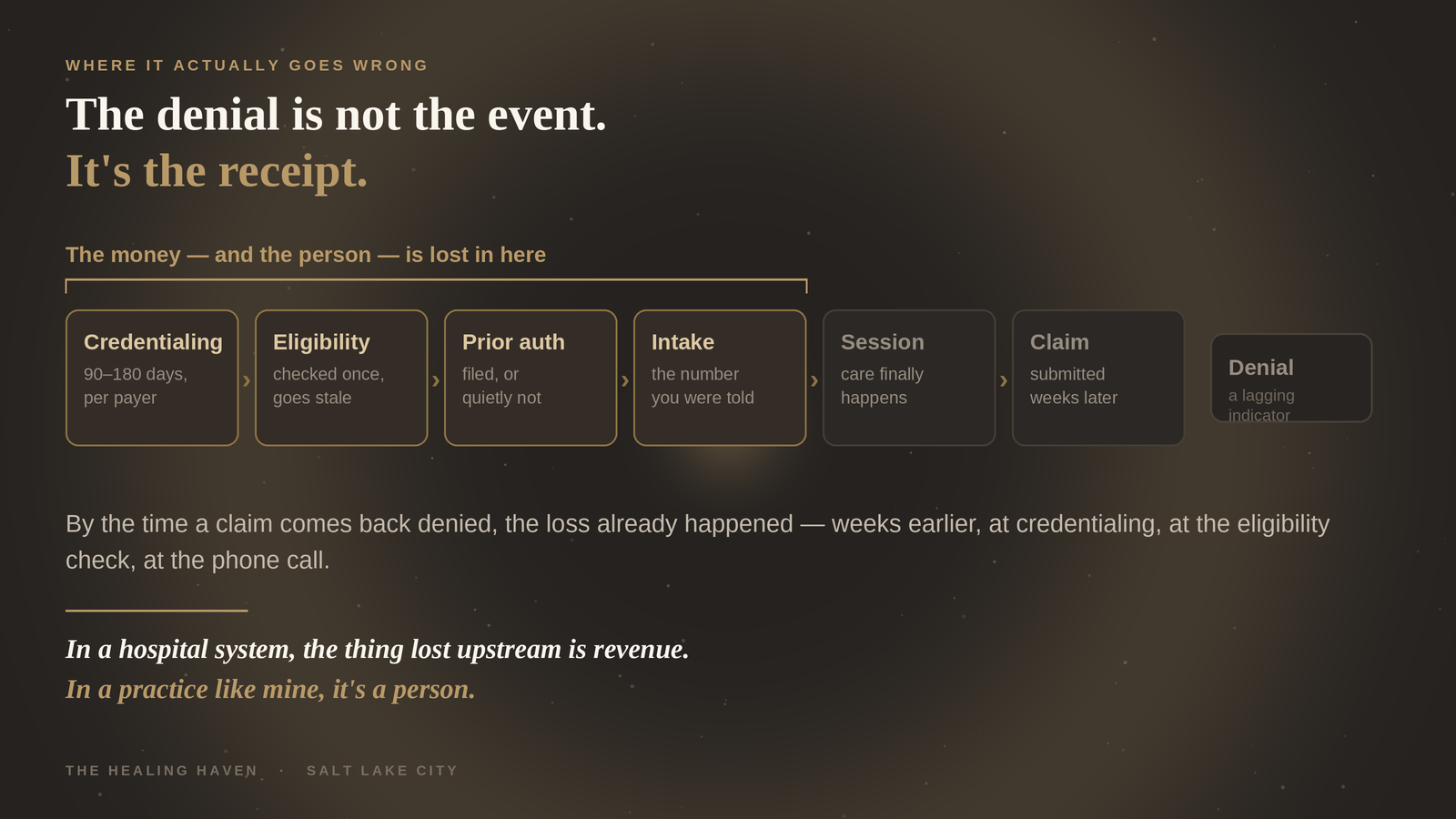
And speaker after speaker made the same argument, which is that the denial is not the event. The denial is the receipt. One panelist called it a lagging indicator — by the time it lands in your inbox, the money is already gone, and it went weeks earlier, somewhere upstream. At credentialing. At the eligibility check. At the prior authorization. At intake.
At the front desk. At the phone call.
One of the panelists, Tammy McMasters Gomez of UC Davis, said something I've been carrying around since: don't lead with efficiency, lead with quantified revenue risk. Meaning nobody in an organization moves because the paperwork is annoying. Everybody already knows the paperwork is annoying. They move when someone can finally say what the paperwork is costing.
Another speaker used the figure of what a single internal medicine provider generates in a day — around $7,300 — as the way to make that real to a board. And a report from the conference host was quoted as finding that 47% of the leaders they surveyed did not know what these upstream workflows were costing them.
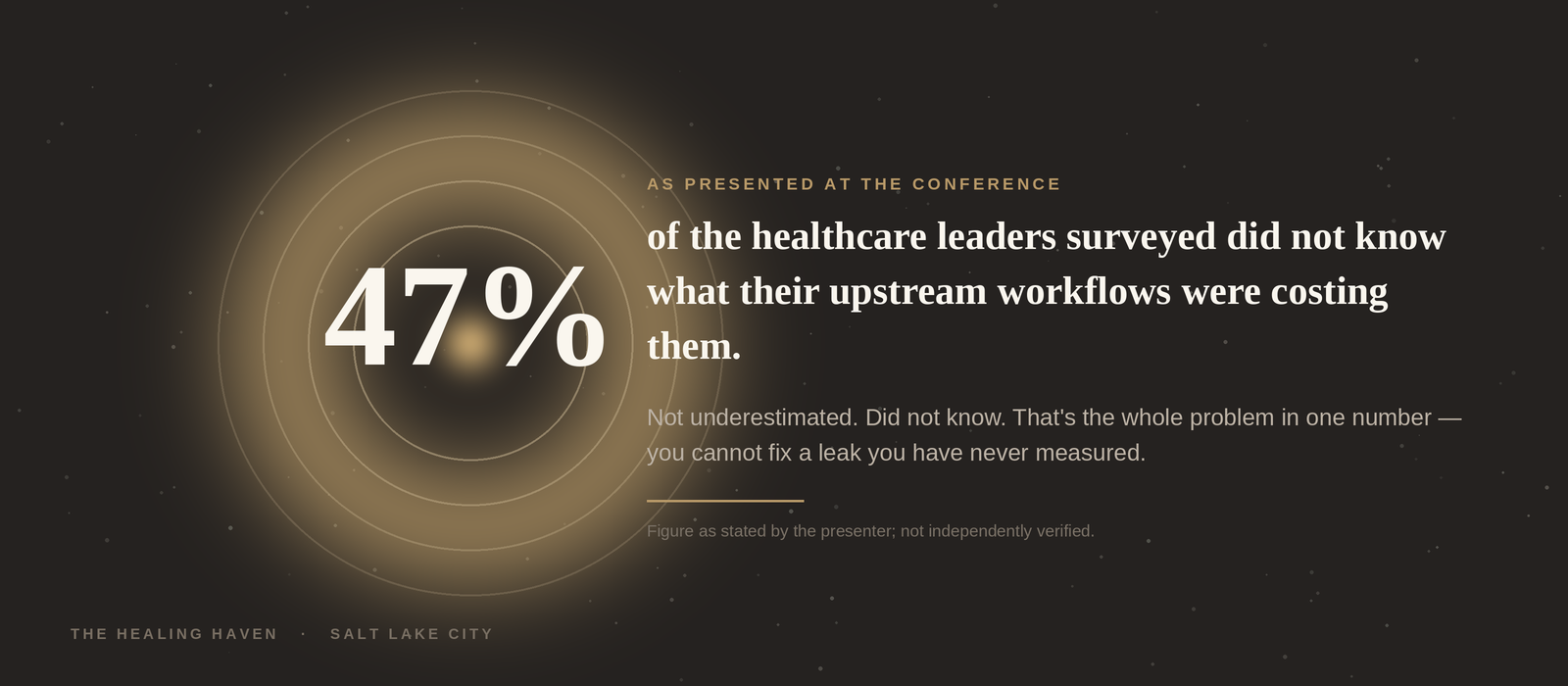
Let me be careful, because this is exactly the kind of number that gets stolen and repeated. Those are their figures, from their rooms, about their kinds of organizations. I'm not going to pretend they map cleanly onto a small trauma practice in Salt Lake City, and you should be skeptical of any therapist who quotes a hospital statistic at you like it's about her.
But the shape of it maps perfectly. And the shape is what got me.
In a hospital system, the thing lost upstream is revenue. In a practice like mine, the thing lost upstream is a person.
What that actually looks like from my chair
Here is the version of it I've lived, more than once.
Somebody calls. They're nervous, because calling a therapist is not a neutral act — most people have rehearsed it in the car. They ask the question everyone asks, which is some version of can I afford this.
And then one of a few things goes wrong.
The eligibility check doesn't get run, because the person who runs it is also the person doing the session at 2pm. Or it gets run and comes back ambiguous, and the ambiguity gets rounded off into something reassuring. Or it gets run correctly in March and nobody re-checks it in June, and by June it isn't true anymore.
So they get told a number. They arrive. The number turns out not to be their number.
And they don't come back.
Not because therapy failed them. Therapy never got a turn. The front of the process failed first, the thing that broke was administrative, and the consequence was clinical — a person who needed EMDR in March and didn't get it, and who now has one more piece of evidence for the story that asking for help doesn't work out for them.
That's what I mean when I say the thing lost upstream is a person. That's not a metaphor I built for a blog post.
What the big systems do that a solo practice simply can't
Two things from that day genuinely impressed me. Both are the kind of thing that has never been available to a practice my size.
The first: one health system codes every single write-off back to the thing upstream that caused it. A registration error. A missed verification. An authorization nobody filed. An enrollment that quietly lapsed. So instead of a pile of unexplained "bad debt" at the end of the year, they have a ranked list of specific broken steps. They can point at the leak.
I have never in my career been able to point at the leak. I've only been able to feel it.
The second: another group runs a bot that continuously crawls insurance company provider directories, compares what each insurer is publishing against what's actually true, and issues an exception report every month.
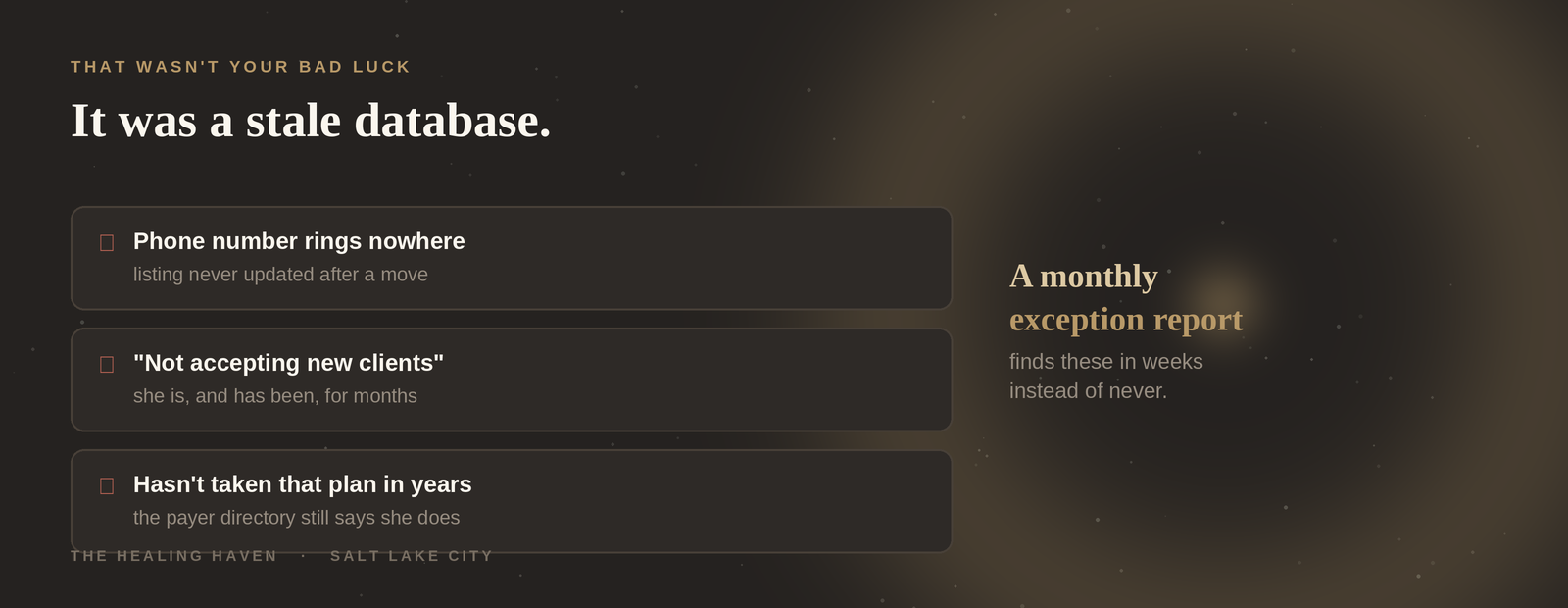
If you have ever called a therapist off your insurance company's website and gotten a disconnected number, or a full voicemail box, or a person who hasn't taken that plan in three years — you have personally met the problem that bot exists to solve. That wasn't your bad luck. That was a stale database.
My honest reaction to both of these wasn't envy exactly. It was closer to grief, and then irritation.
Because a solo therapist has exactly zero chance of doing either one by hand. Not because she isn't smart enough, and not because she doesn't care enough. Because she has clients on Tuesday. The reason big systems fix these problems and small practices don't isn't insight. It's staffing.
So we built it anyway
I'm a therapist, not an engineer. What I have is a clear picture of what The Healing Haven is supposed to become — a Salt Lake City practice where the administrative machinery never gets to decide who receives care — and a team that was willing to build toward that picture with me instead of telling me it was just how things are.
Zack took the problem apart the way I take a trauma history apart: what is actually happening, in what order, and where does it keep breaking. Sonja Scriven, our Group Practice Manager, lives inside the daily operations all this paperwork lands on, so when the fixes started turning into real software, she became its product manager.
We call the result PracticeOS. The Healing Haven is its founding practice, which means every piece gets built here and proven on real clients, real payers and real deadlines before it's anything else.
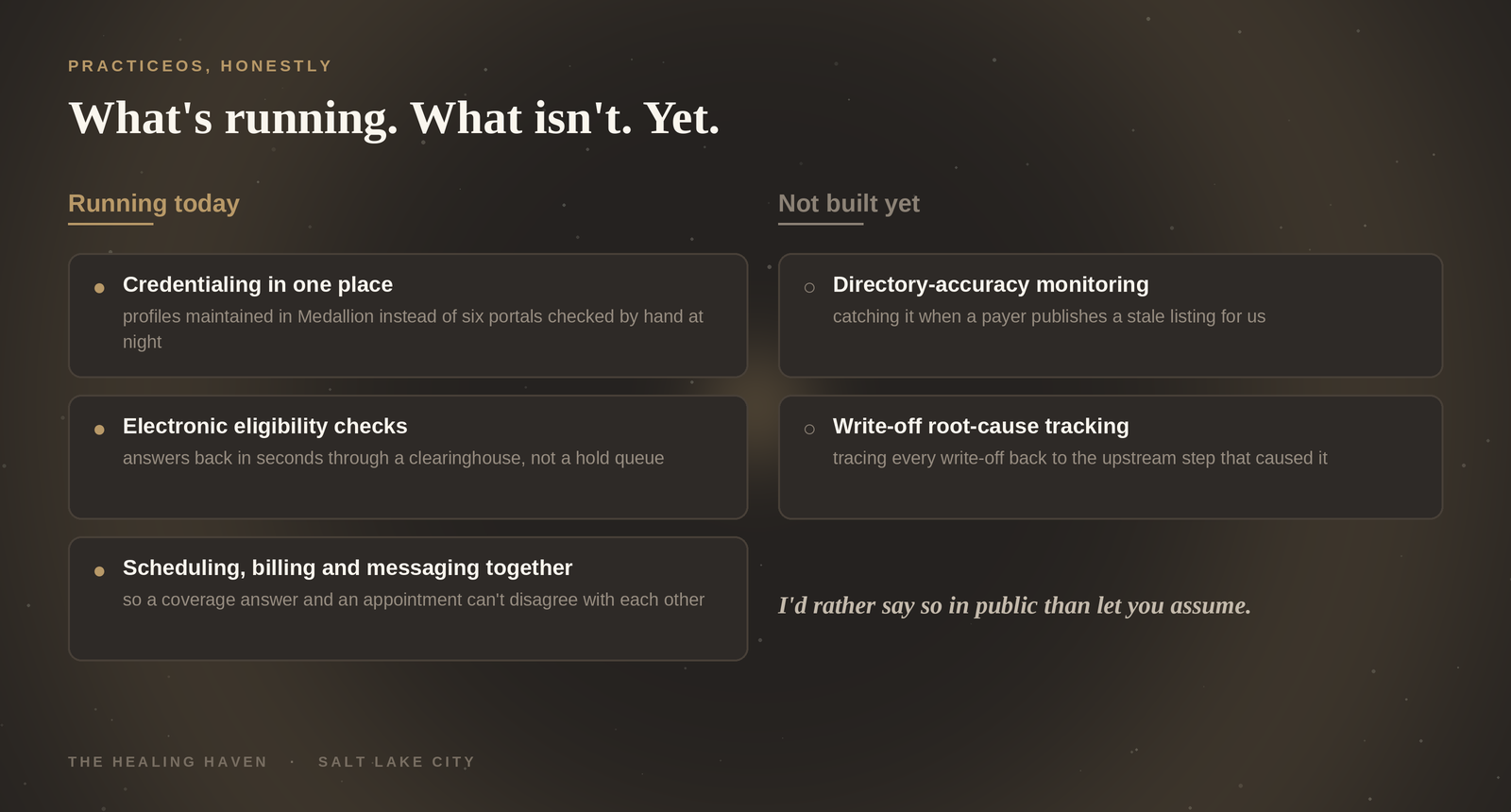
I'd rather publish the right-hand column than let you assume it's all finished. The directory monitoring is on our list, not in our product. The write-off tracking is a version behind what that health system described. I'll write about each when they're real, and not before.
The part I'd tell every single client to pay attention to
There was a policy session about the federal budget law passed this year and what it does to Medicaid.
I'm going to be more conservative about this than the internet will be. That session described national effects; nobody walked it down to Utah, or to behavioral health specifically, and I'm not going to do that walking for them in public.
What was described: the changes land hardest on the population covered through Medicaid expansion, and they arrive mostly as tighter eligibility rules, more frequent verification, work requirements and new out-of-pocket costs. Not, primarily, as a cut to what providers get paid.
Sit with what that means for a person who is in therapy right now.
The risk to you probably isn't that your therapist stops accepting your plan. It's that your coverage changes in the middle of your treatment — while you're eight sessions into trauma work and it has finally, finally started to move.
I've watched treatment get interrupted for administrative reasons before. It's one of the few parts of this job that makes me genuinely angry, because the clinical cost is real and the cause is a piece of mail.
I don't yet know exactly how or when this lands in Utah. I'm not going to guess in public. My team is running it down against actual Utah sources, and I'll write it up honestly when I have something I can stand behind.
What I can tell you is what it has already changed here: we treat coverage as something to re-check, not something to verify once at intake and file away.
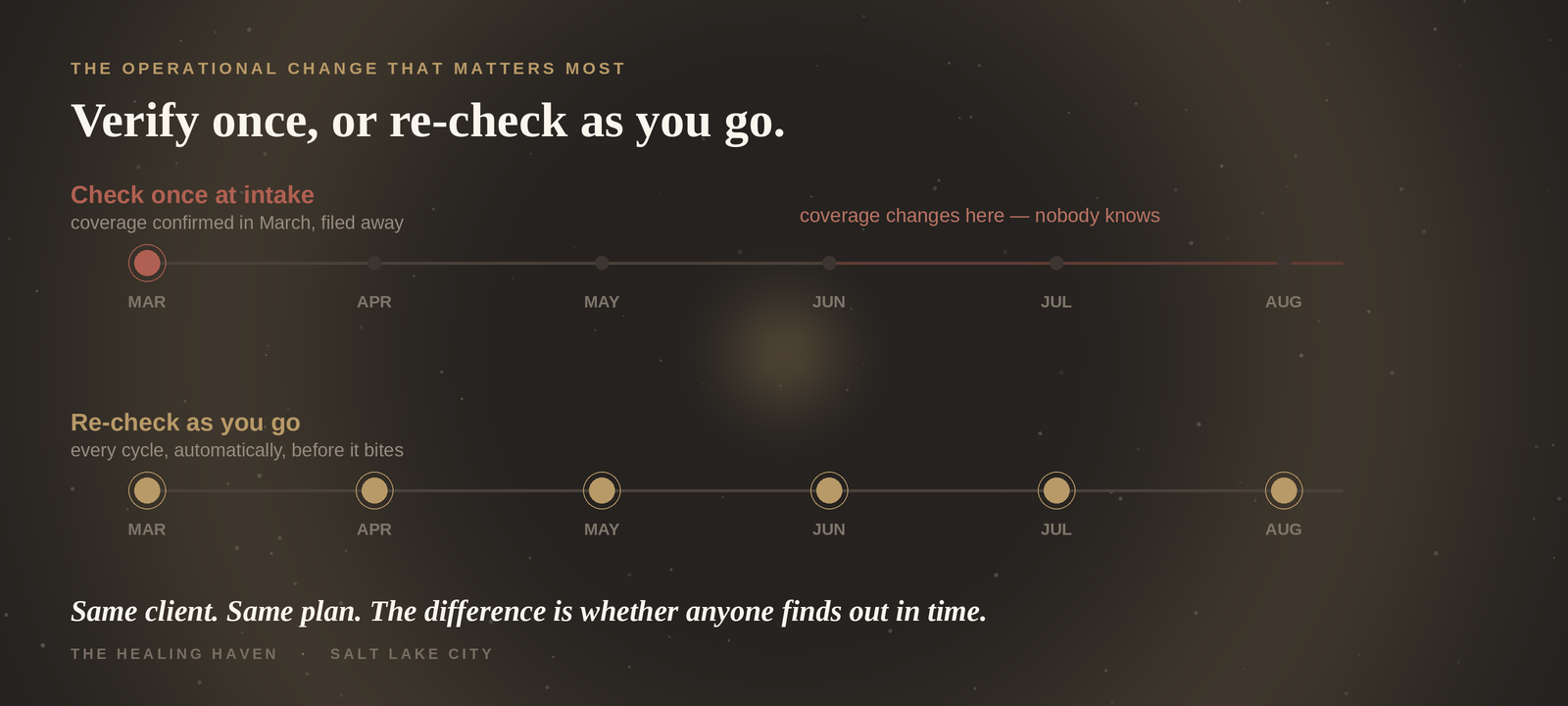
It's a small operational decision. I think over the next year it will be part of the difference between people finishing their treatment and people quietly disappearing from it.
The part I didn't expect to feel
I went into that policy session braced. A day of billing panels in a year like this one, and I assumed I'd come out more anxious than I went in.
I came out steadier. That surprised me enough that I want to name why, because I think it matters more than any single fact in my notes.
The presenters made an explicit point of saying they were approaching all of it on a bipartisan basis. No spin, no campaigning. Just: here is what changed, here is what it does, here is what you'll need to do about it.
Zack pointed out afterward that there are people who'd call announcing your own bipartisanship a partisan act. He's not wrong, and I laughed. But I'll take it. I sat through an entire session about a law with real consequences for people I see every week, and nobody tried to make me angry at anyone. They told me what to prepare for.
I notice tone for a living. Regulation — the actual nervous-system kind, not the government kind — is most of what I'm doing in a room with a client. And the thing that settles a person is almost never reassurance that everything is fine. The body doesn't believe that. What settles a person is somebody calm telling them the truth about what's coming and what can be done about it.
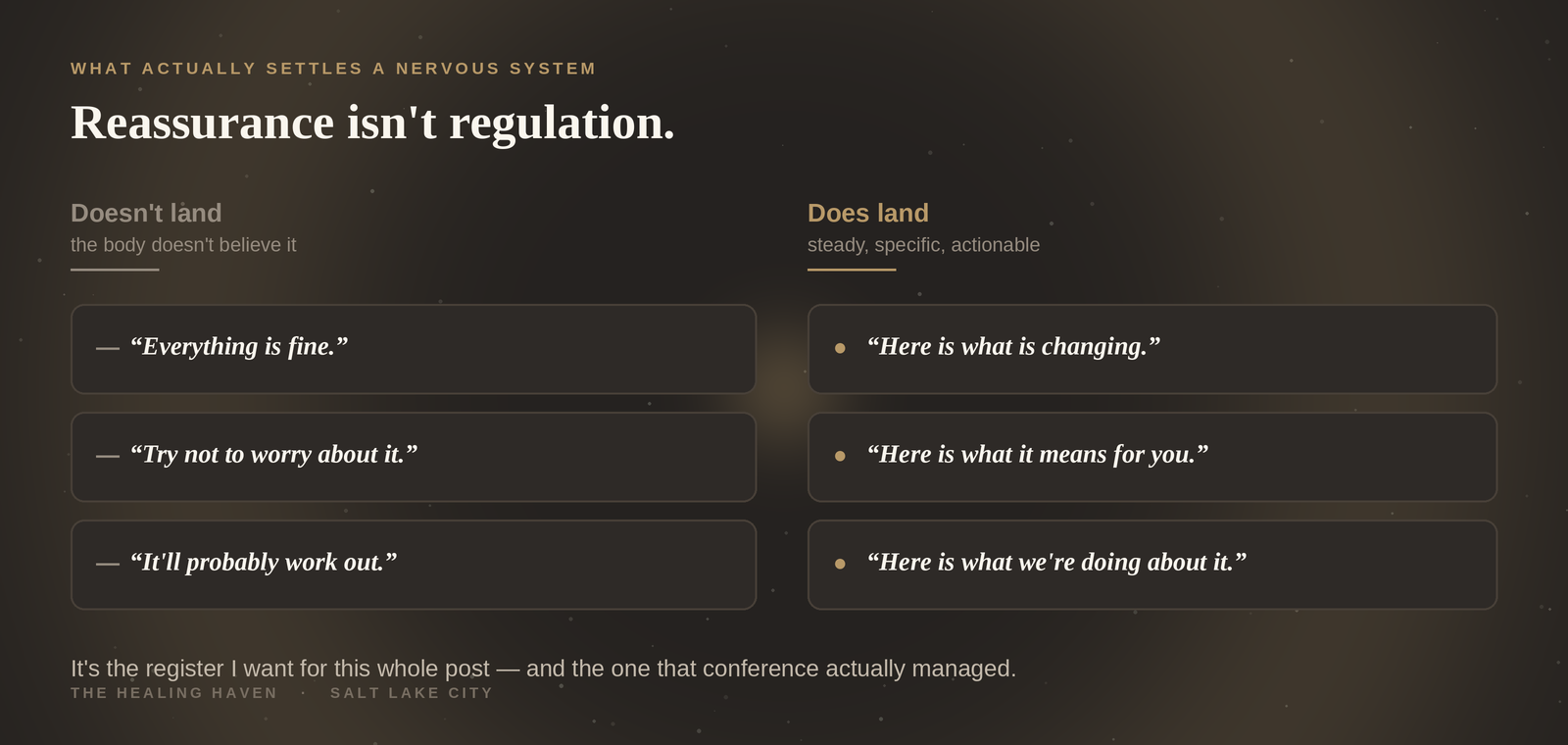
That's what eight hours of that conference turned out to be, and it's the register I'm trying to write in here. Things are changing. Some of it will be hard. Nobody in that room pretended otherwise, and nobody catastrophized either.
If you're a person whose coverage might shift this year, I'd much rather hand you that than a panic.
On the AI question, since everyone asks me now
Half that conference was about artificial intelligence, and the most useful thing anyone said all day was a criticism.
A health system executive, describing what most healthcare AI actually delivers in practice, called it a dashboard on top of the queue. Her organization had eliminated zero positions with it. Another speaker's test for any automation was one question: did it remove the work, or did it just move it?
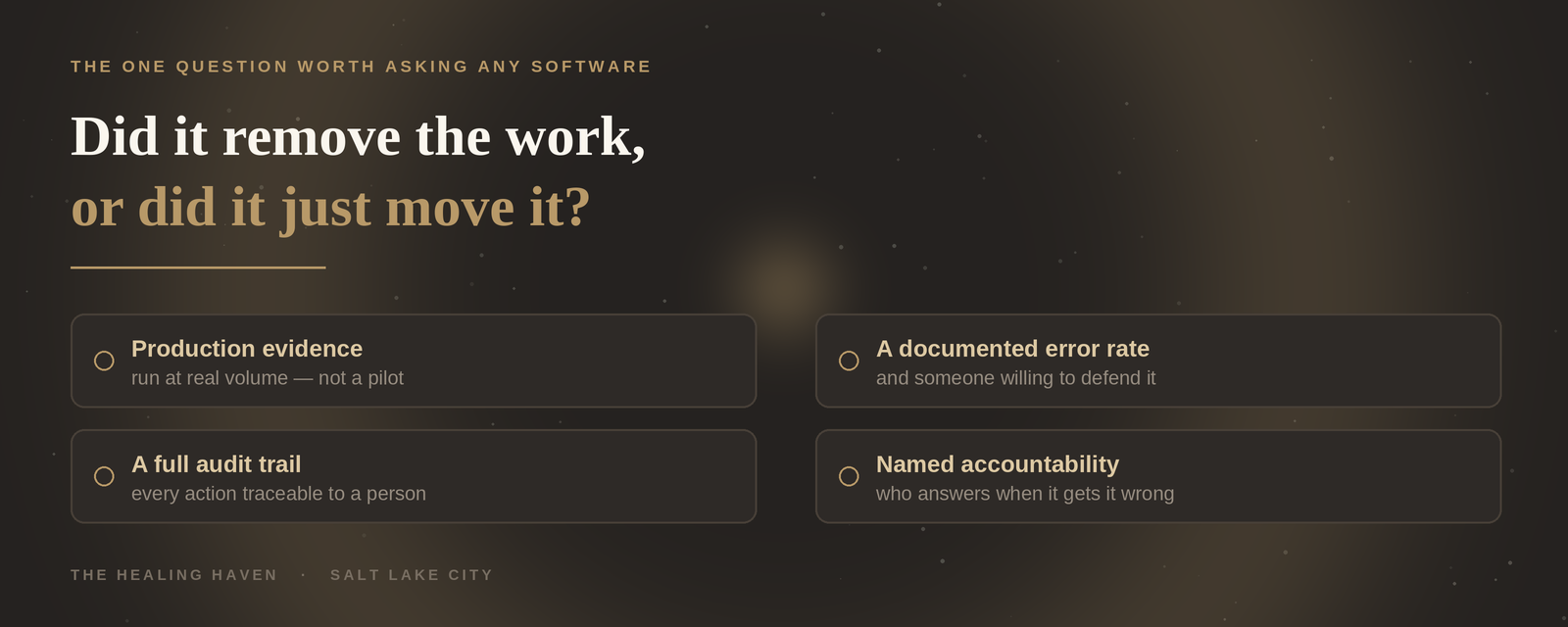
That checklist was the most grounded thing I heard all day. And I'm building software, so it's pointed straight at me. I think it should be.
Here's the version I hold myself to, and you're welcome to hold me to it: nothing we build touches a clinical decision. Every place it handles your information, a specific human being on my team reviews it and is accountable for it. And when it gets something wrong, the person answering for that is me, by name, with a license attached.
If any therapist ever tells you her software decided something about your care, ask the second question. Did it remove the work, or did it just move it — onto you?
What all of this means if you're the one trying to get in
None of it changes the practical answer, which is the same as it was last week:
Utah Medicaid. If you're covered, your cost is $0. No private payment is collected from Medicaid clients, ever. Coverage and fit get verified before anything is scheduled — and now, re-verified as we go.
Commercial insurance. I'm currently out-of-network, and I'm inside that credentialing process I described last week. Meanwhile, "out-of-network" shouldn't automatically scare you off: many plans reimburse a real portion of out-of-network mental health care. You pay the session rate, I give you a superbill, you submit it to your plan. Some people get back a meaningful amount. Some get back nothing. The only way to know is to check your specific plan, and I will check it with you for free.
Paying directly. A session is $189. Healing Membership starts at $97/month and includes group access, the member community and a session; active members can request additional sessions at $123 when my calendar allows. All the payment options are here.
The free coverage consult. Fifteen minutes. No cost, no card, no obligation. We sit down together and find out what your plan will and won't actually do before you commit to anything. If the honest answer is that this isn't affordable for you here, I would far rather tell you that for free than after you've paid for a session.
What I actually took from that day
A room full of people running enormous organizations spent eight hours agreeing that healthcare loses people at the front door, not at the end of the process — and managed to say it without once making it feel like the sky was falling.
They're right. And the reason it keeps happening to small practices specifically is that every tool built to fix it was designed for hospital systems and priced for them too. The problem trickles down. The solutions don't.
I don't think a person in Salt Lake City should lose access to trauma care because the administrative layer of American healthcare was built for someone a thousand times larger. I can't fix that for everyone. I could refuse to let it be the reason somebody doesn't get care with me — so we're building our way out of it here, in public, one piece at a time, and writing down what we learn as we go.
The mocktail kit was a nice touch. It worked, too — I'm still thinking about that day.
If the last round of phone calls went badly, try one more.
Start with the free coverage consult. Let's find out what's actually possible for you.

Helen De Lovely, LCSW, is the founder of The Healing Haven in Salt Lake City — the founding practice of PracticeOS — where she works with clients on trauma, adult ADHD, and nervous-system healing through EMDR and somatic approaches. Zack Scriven is Practice Growth Director; Sonja Scriven is Group Practice Manager and product manager for PracticeOS. Figures and quotations attributed to conference speakers above are as presented by those speakers and have not been independently verified by The Healing Haven. Nothing here is a prediction about any individual insurance plan.