Free Mental Health & Community Resources in Utah: What 211 Actually Does?
By Helen De-Lovely, LCSW — The Healing Haven SLC
Something I keep coming back to lately: how much of mental health access in Utah comes down to knowing where to look.
Utah 211 exists exactly for this. One call or text connects you to housing help, financial assistance, crisis support, and mental health resources across the state — no matter your insurance situation.
If you're navigating a hard season and don't know where to start, that's a genuinely good first call. Community care isn't just what happens in a session. It's the whole web of resources around it.
Key Takeaways
Utah 211 is a free, confidential line that connects anyone in Utah to housing, financial, food, utility, and mental health resources — regardless of insurance status.
Call 211 or 888-826-9790— available 24/7.
Text your zip code to 801-845-2211— Monday–Friday, 8am–5pm.
Chat at hfuw.org/chat, or search the database anytime at 211utah.org.
211 is not a crisis line. For active suicide, mental health, or substance use crises, call or text 988 instead. 211 can connect you to 988 if that's what you need.
This is general information about a public resource, not a personalized recommendation or a substitute for therapy or emergency care.
In This Article
Why I keep coming back to this
What Utah 211 actually does
How to reach 211
211 vs. 988 — which number you actually need
The kinds of things 211 can help with
Community care is bigger than the session
Frequently asked questions
Why I Keep Coming Back to This
So much of what makes a hard season harder isn't the season itself — it's not knowing where to start. Clients come in carrying a housing notice, a shut-off notice, a gap in coverage, on top of whatever brought them to therapy in the first place. Therapy can hold a lot, but it was never meant to hold all of it alone.
That's what keeps bringing me back to Utah 211. It's free, it's confidential, and it exists specifically for the moment when you know something needs to change but you don't know which door to knock on first.
What Utah 211 Actually Does
Utah 211 is a collaborative service run by the United Ways of Utah, connecting people to more than 3,000 service providers and nearly 10,000 health, social, and government services across the state. You talk to a real person — a trained Information Specialist — who asks a few questions about your situation and points you toward specific, local resources that can actually help, then follows up to make sure you got what you needed.
It's not a hotline for one specific problem. It's a front door to almost everything: housing and eviction prevention, utility and financial assistance, food access, family support, health and wellness referrals, and connections into the mental health system.
How to Reach 211
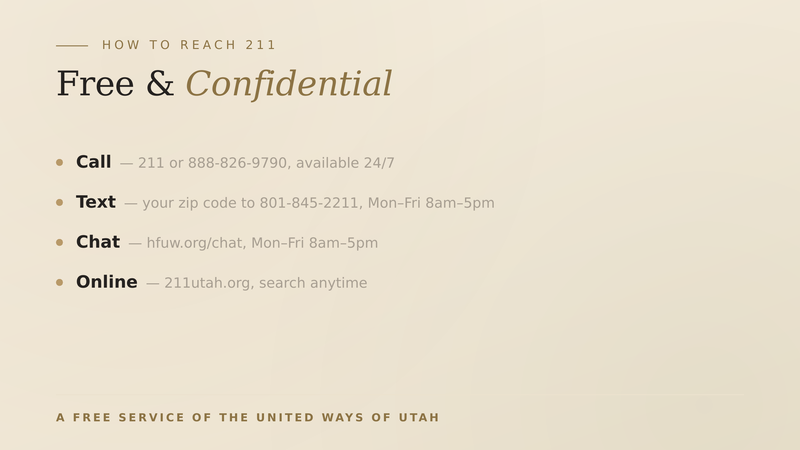
There's more than one way in, depending on what's easiest for you in the moment:
Call — Dial 211, or 888-826-9790 from a mobile device. Phone support is available 24/7.
Text — Text your zip code to 801-845-2211. Available Monday–Friday, 8am–5pm.
Chat — Talk to a specialist online at hfuw.org/chat. Available Monday–Friday, 8am–5pm.
Search online — Browse the statewide resource database yourself anytime at 211utah.org.
All of it is free. None of it requires insurance, and you don't need to know the "right" way to describe your situation — that's what the Information Specialist is there to help sort out.
211 vs. 988 — Which Number You Actually Need
These two numbers get confused, and the difference matters, so it's worth being direct about it.
211 is for navigating a hard situation— housing, money, food, utilities, and connecting into mental health and family support services. It's the number for "I don't know where to start."
988 is the Suicide & Crisis Lifeline— for active suicide risk, a mental health crisis, or a substance use crisis. You can call or text 988 anytime, 24/7, and reach a crisis counselor at Utah's Huntsman Mental Health Institute. It's free and confidential.
If you contact 211 and what you actually need is crisis-level mental health support, the Information Specialist can connect you to 988 directly. You don't have to know which one you need before you reach out — either door gets you moving in the right direction.
The Kinds of Things 211 Can Help With
A few concrete examples of what people actually use 211 for:
Housing — rental assistance, eviction prevention, shelter access
Utilities — help before or after a shut-off notice
Food — food banks and pantries near you
Financial assistance — programs based on your household situation
Family support — childcare resources, support for older adults, disability resources
Health and mental health — referrals into the broader care system, including a warm connection to 988 when needed
If you're not sure whether your situation "counts," it counts. That's genuinely what the line is for.
Community Care Is Bigger Than the Session
I think about this a lot in the work I do. A client can show up every week, do the work, and still get knocked sideways by something a single phone call could have started fixing months earlier.
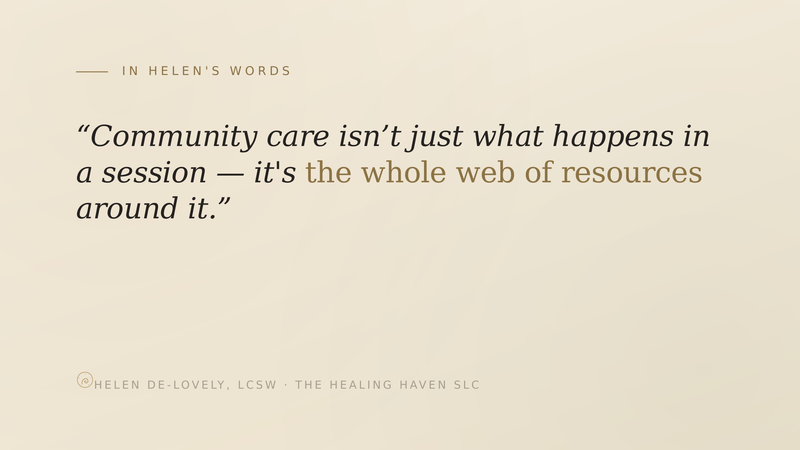
In Helen's words:"Community care isn't just what happens in a session — it's the whole web of resources around it. Knowing where to look is half the battle, and Utah 211 is a genuinely good place to start."
If you're a client here, or thinking about becoming one, and you're also navigating something practical alongside the emotional work — housing, money, access — it's worth bringing up. It's part of the whole picture, not separate from it.
The Healing Haven SLC is located at 250 E 200 S, Suite 1521, Salt Lake City, UT 84111. Reach me at (385) 443-4045 or [email protected].
Schedule a free 15-minute consult — it's a conversation, not a commitment.
Frequently Asked Questions
What is Utah 211?
A free, confidential referral line and online database run by the United Ways of Utah, connecting people to housing, financial, food, and mental health resources across the state.
Is Utah 211 the same as 988?
No. 211 helps you navigate a hard situation and find resources. 988 is the dedicated Suicide & Crisis Lifeline for active mental health, suicide, or substance use crises. 211 can connect you to 988 if that's what you need.
Does it cost anything, or do I need insurance?
No. Utah 211 is free and available regardless of insurance status.
What if I need help right now, in a crisis?
Call or text 988 — available 24/7. If you're in immediate physical danger, call 911.
Does Utah 211 only cover Salt Lake City?
No. It covers the entire state of Utah, though the specific resources you're connected to will be local to your area.
Is what I share private?
Yes. 211 Information Specialists ask some optional demographic questions to help match you with resources, but you're never required to answer them, and the service is confidential.
This article is for general informational purposes only and is not medical, legal, or financial advice, and does not establish a therapeutic relationship. The Healing Haven is not affiliated with or endorsed by 211 Utah or United Way — this is an independent recommendation of a public resource. If you are in crisis, please contact the 988 Suicide & Crisis Lifeline by calling or texting 988. If you are in immediate danger, call 911.
Sources
211 Utah. "Connect with Utah 211." 211utah.org/get-help/connect-utah-211
Utah Department of Health and Human Services. "Call or text 988 — 24/7 Suicide and Crisis Lifeline." 988.utah.gov
Utah System of Higher Education. "Connect with Utah 211" (school counselor reference card). ushe.edu
United Way 211. "211 Celebrates the Launch of 988." 211.org