Why Setting Boundaries Feels Wrong (and What to Say Anyway)
You said yes before you finished hearing the question. Then, somewhere between the yes and the drive home, your stomach caught up.
If that sounds familiar, you are not bad at boundaries. Boundaries tend to feel wrong for reasons that make complete sense, and most of those reasons were learned long before you had a say in it.
This post grows out of Episode 4 of The Salt Lake City Therapist, "Why Setting Boundaries Feels Wrong," which I recorded with Jade Andersen. You can watch the full conversation on YouTube. Below are the ideas that stayed with me, plus some example sentences you can borrow and adapt.
What a boundary actually is
On the episode, we described a boundary as consistent structure: a way of making sure something will be followed, without shame attached to it. It is not a punishment, and it is not a wall.
One idea worth holding onto: a boundary is a request that comes with a promise, and the promise is about what you will do, not about what the other person will do. That is what separates a boundary from a complaint.
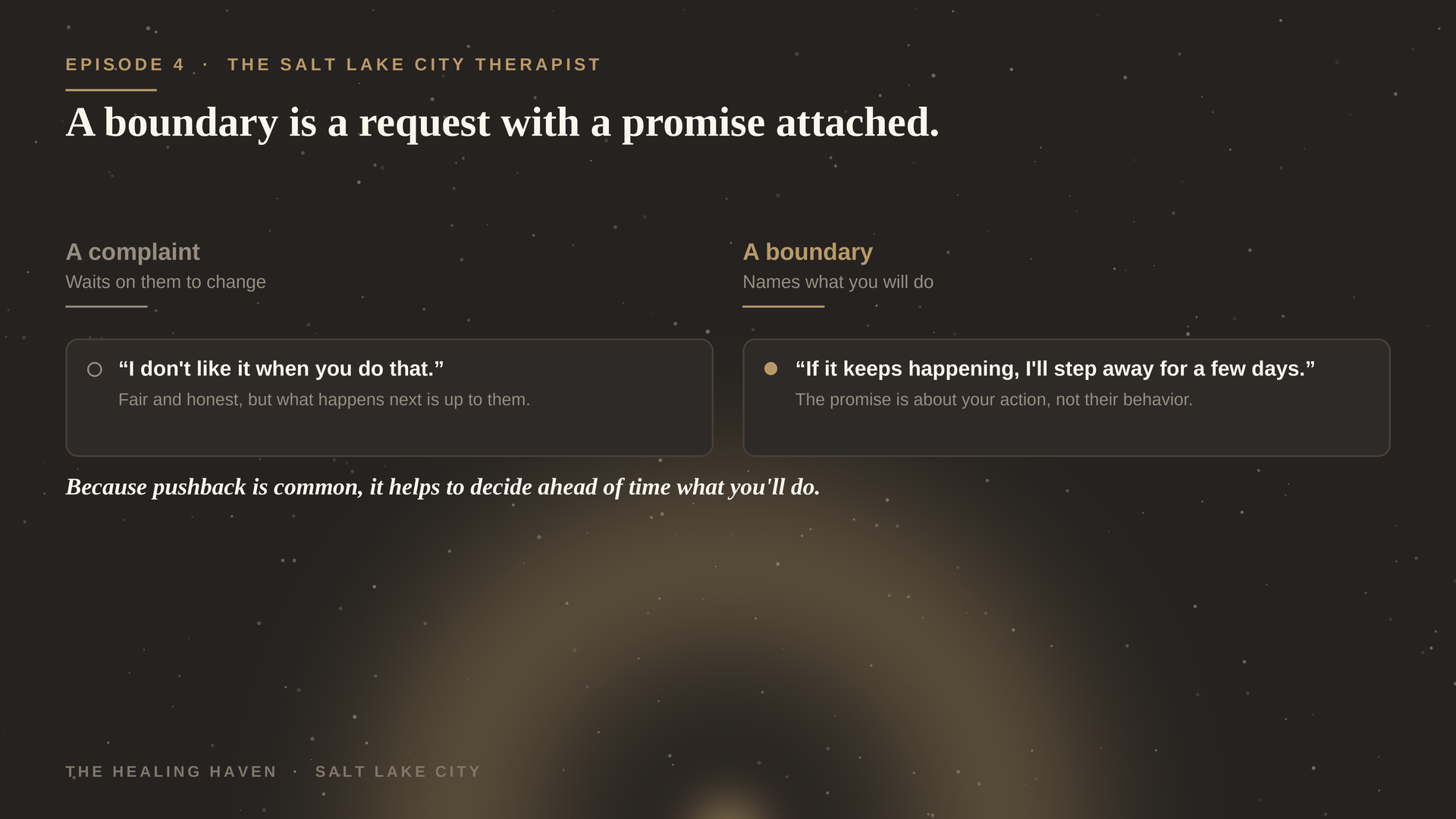
A complaint sounds like, "I don't like it when you do that." That can be fair and honest, but what happens next is up to them. A boundary sounds more like, "If it keeps happening, I'll step away for a few days." The second sentence is about your action. It is the part you can actually follow through on.
We also talked about how a boundary can change over time. It is more like a map that shifts as your values do than a rule carved in stone. What you needed last year may not be what you need now, and that is allowed.
Why saying no can feel so wrong
If setting a boundary makes your chest tighten, there is usually a reason underneath. A few of the ones we talked about:
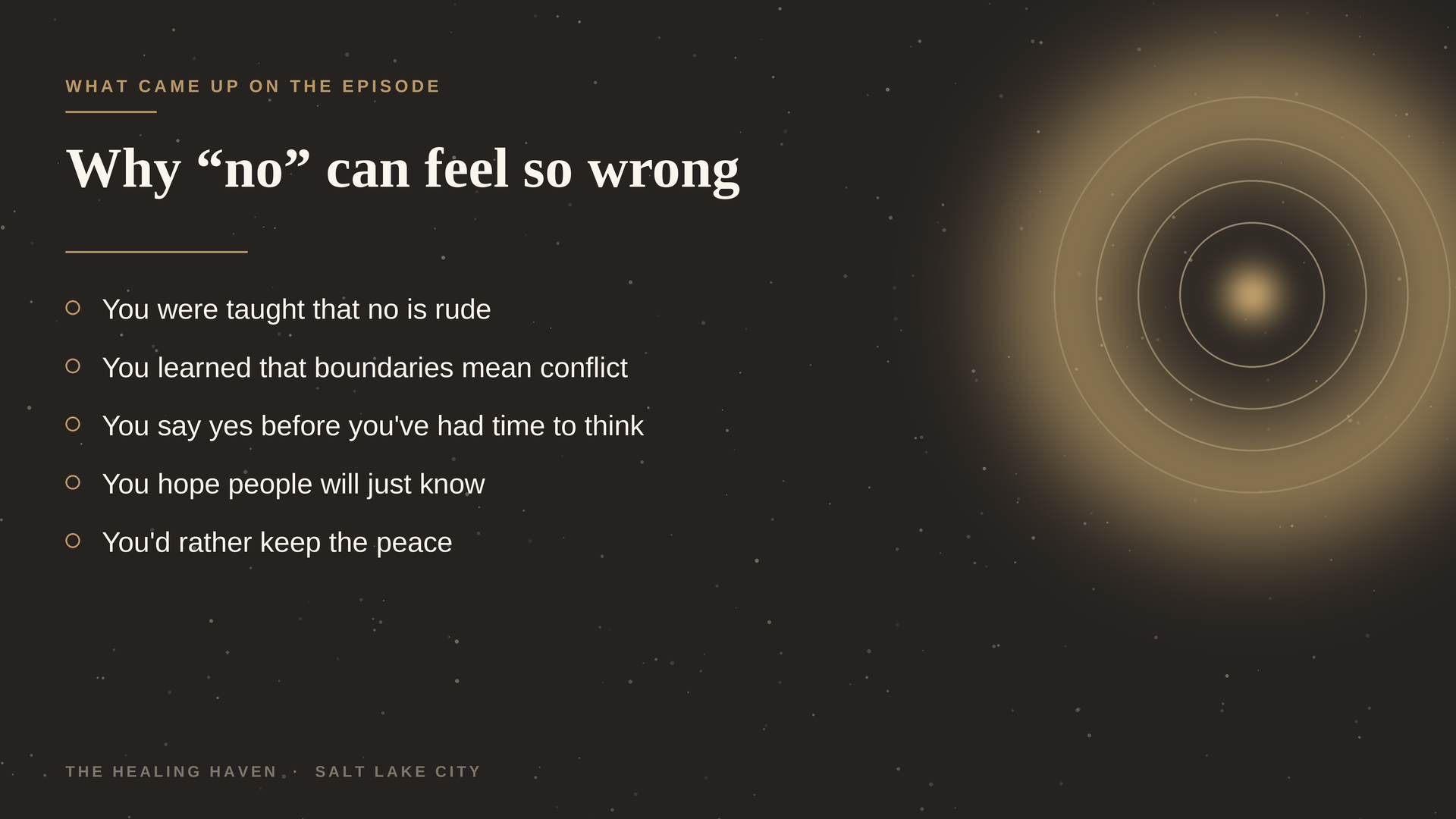
You were taught that no is rude
One example from the episode: a child being expected to hug a relative, and a "no" being read as ungrateful or impolite. When that is the lesson, an adult "no" can arrive with a lot of old weight on it. We also noted that this is shifting, and that many kids now are encouraged to have boundaries of their own.
You learned that boundaries mean conflict
If you absorbed the idea that setting a boundary means a fight, or that it makes you an unkind or unpeaceful person, then of course it feels conflicting. That belief is worth naming out loud. Noticing it is often the first step to moving past it.
You say yes before you have time to think
On the episode, we talked about how neurodivergent people often say yes before really considering what is being asked, in part because they want to be helpful. The result can be a yes that your body regrets, sometimes as anxiety you feel in your stomach. If that resonates, this may help: what neurodivergent-affirming therapy looks like in Salt Lake City.
You hope people will just know
Many of us wish the people closest to us could read our minds. But as we said on the episode, telling someone what you need means asking, and asking can mean doing the scary things. Expecting someone to guess is a way of avoiding that, and it rarely works out the way we hope.
You would rather keep the peace
Wanting to avoid conflict and drama is not a flaw. It can also mean letting things slide with the people you care about. Keeping the peace and having boundaries are not opposites, even if it can feel that way.
Boundary examples you can adapt
These are illustrations, not a script to memorize. Change the words until they sound like you. Each one is built around the same idea: say what you need, and say what you will do. The graphic shows four; a few more follow.
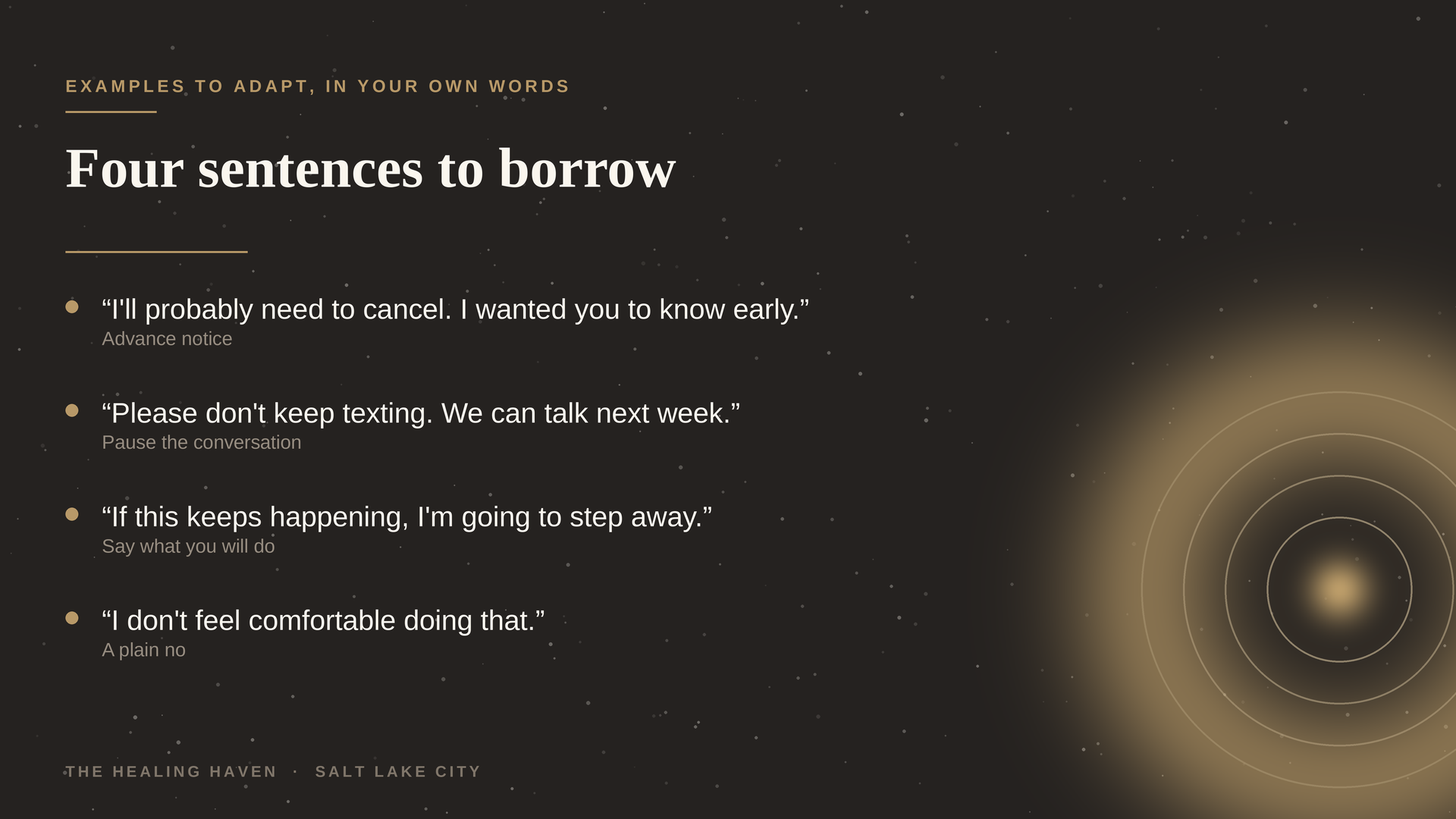
Give advance notice. If your time or energy is limited, say so early. "I'll probably need to cancel. I wanted you to know early." On the episode, this came up as telling friends ahead of time when your availability is limited. The conversation also used the idea of "spoons," a way of describing how much energy you have to spend.
Pause the conversation. "Please don't keep texting. We can talk about this next week." Pausing is a boundary, and it gives you room to come back to the conversation on your own terms.
Say what you will do. "If this keeps happening, I'm going to step away." On the episode, one version of this went as far as blocking someone for a few days. That is one option. Muting, leaving a conversation, or taking a break from replying are gentler versions, and you get to choose what fits the situation. Whatever you pick, it only works if you are willing to follow through.
Say the hard sentence kindly. "You're doing nothing wrong here, but this is what I need, and if I can't have that, this isn't going to work. No hard feelings." It can be a lot to say. It is also honest, and it leaves room for the other person to respond.
A plain no. "I don't feel comfortable doing that." Or, "That doesn't work for me. Not today." You are allowed to stop there. We are not little kids; we can say no.
A boundary in a professional setting. One example from the episode is about texting a therapist. The idea was to make clear that the practice is non-emergency, that someone who is in crisis or needs immediate help should call or text 988, and that in a life-threatening emergency they should call 911 or go to the nearest emergency room. Setting that expectation can also take pressure off, because no one has to wonder whether a message will be answered right away.
What to expect afterward
Setting a boundary does not always feel good right away. On the episode, we talked about a few things that can come with it:
- It can feel lonely at first. Reminding yourself that you are worth the boundary is part of the work, and it may take repeating.
- Some people push back. That is common, especially if they are used to you saying yes.
- Relationships can shift. People are not always used to a new boundary, and sometimes they struggle with it. Sometimes a relationship changes a lot, or ends. That can be hard, and it is part of what is real about this.
- It takes practice. It can be tiring. It is a process, and it is okay if you are still learning it.
A note on safety: if a boundary involves someone who has hurt you, or if you worry that setting one could put you at risk, please think about your safety first. Reach out to a therapist or a trusted person before acting, and do what keeps you safe.
A small place to start
You do not need to set every boundary at once. Pick one situation where a yes keeps costing you something. Write down one sentence that names what you need and what you will do. Say it out loud once, alone, before you say it to anyone else.
If you would like support with this, I offer a free 15-minute consult to talk through what you are looking for. Book a free 15-minute consult. If you are weighing practical questions first, you may find does my insurance cover therapy in Utah helpful. Some of the body-based work I do, like somatic approaches, can also be part of how people learn to notice what a yes feels like in their body. Whether that fits you is something we would talk through together.

Helen De-Lovely, LCSW, is a Salt Lake City therapist who works with trauma, adult ADHD, and nervous-system healing through EMDR and somatic approaches. The podcast episode this post draws on was recorded with Jade Andersen. This post is general educational information, not therapy or individualized advice, and reading it does not create a therapist-client relationship. The example sentences are illustrations; what works varies from person to person, and outcomes are not guaranteed. If you are in crisis, call or text 988. In a life-threatening emergency, call 911.