Why the Wait Is So Long
By Helen De-Lovely, LCSW — The Healing Haven SLC
You called six therapists.
Three never called back. Two aren't taking new clients. The one who is has an opening in four months, and only on Tuesdays at 2pm, and you work Tuesdays at 2pm.
Somewhere in there you probably decided the problem was you. That you'd waited too long to call, or picked the wrong week, or that everyone else got in line first.
It isn't you. And it isn't that therapists don't want to see you.
It's a word almost nobody outside this field has ever heard, and it quietly decides whether you can afford care: credentialing.
What credentialing actually is
Before a therapist can bill your insurance, that insurance company has to formally approve her. Not her practice — her, personally, by license and by name.
That process means verifying her degree with the school. Verifying her license with the state. Verifying her malpractice coverage, her work history, her references, her national provider number. Then the same packet gets submitted separately to every single insurance company she wants to accept, each with its own portal, its own forms, and its own timeline.
Each one takes somewhere between 90 and 180 days. They don't run in parallel unless someone is actively pushing all of them at once. And if one document expires while another payer is still reviewing — a license renewal, a malpractice certificate, an address change — you start pieces of it over.
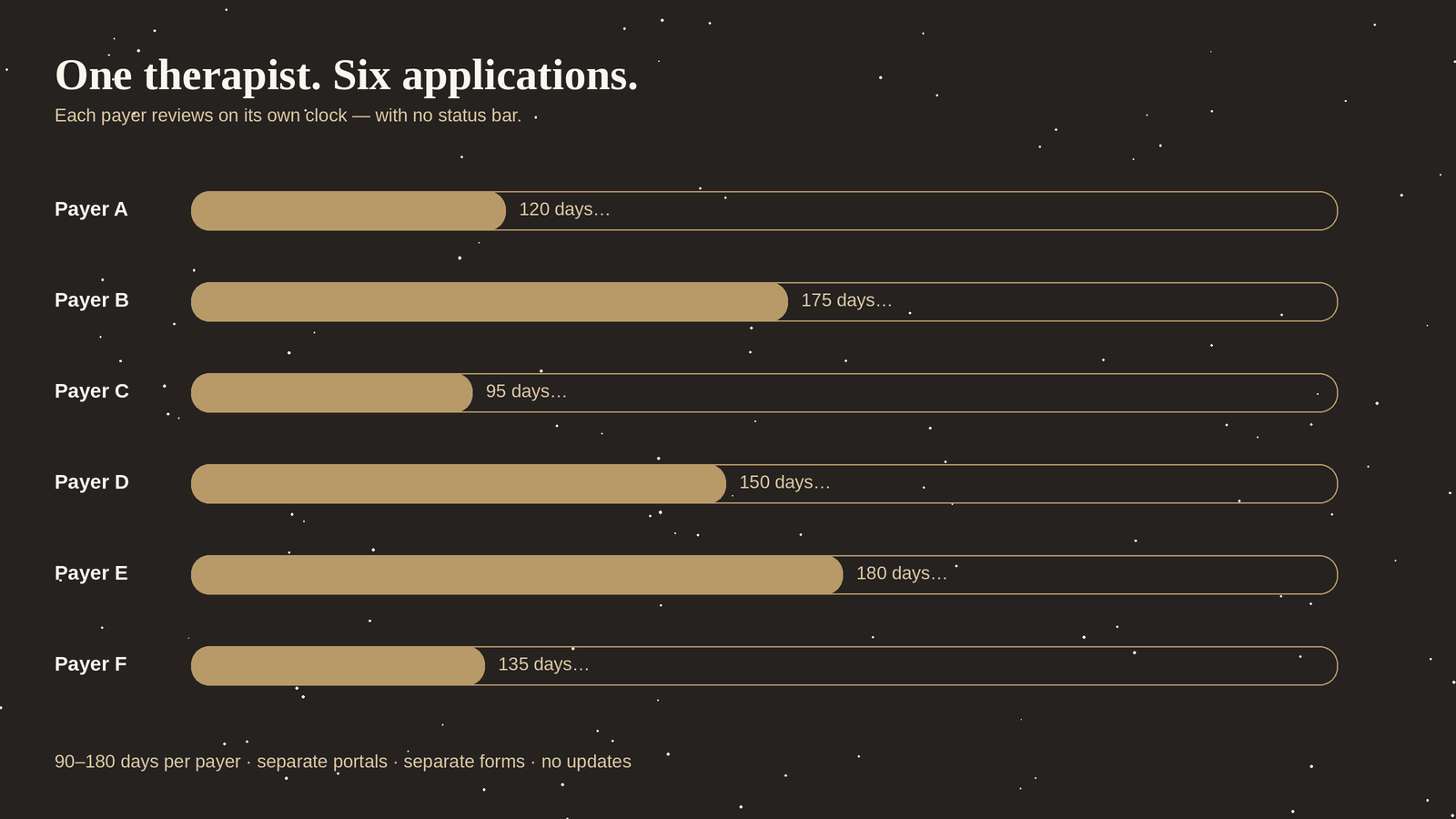
So when a therapist says "I'm not in-network yet," what's usually true is that she's somewhere inside a six-month administrative process with no status bar on it.
That's the wait. Not demand. Paperwork.
The part that made me stubborn
I opened The Healing Haven because I wanted to do trauma work — EMDR, somatic work, nervous-system work — with people who needed it in Salt Lake City.
I did not open it to spend my evenings logging into six portals to check whether anyone had looked at a form.
But that's what the first stretch looked like. I'd finish a day of sessions and then sit down to the second job: tracking which application was where, which document had gone stale, which payer had gone quiet, whether the thing I submitted in the spring was still sitting in someone's queue.
Nobody sends you a status update. You just check. Over and over. And every hour spent checking is an hour not spent with a client, or resting so I can actually be present with the next one.
At some point I stopped accepting that this was just the cost of doing business.
So we built the thing that didn't exist
I'm a therapist, not an engineer. What I did have was a clear picture of what The Healing Haven is supposed to become — a group practice in Salt Lake City where the administrative machinery never gets to decide who receives care — and people willing to build toward that picture with me.
Zack Scriven, our Practice Growth Director, took the problem apart the way I take a trauma history apart: what's actually happening, in what order, and where it keeps breaking. Sonja Scriven, our Group Practice Manager, lives inside the day-to-day operations that all of this paperwork lands on — so when we started turning our fixes into real software, she became its product manager too.
Together, over the last year, we built our own operating system for this practice. Credentialing tracking, insurance eligibility checks, billing, scheduling, client communication — stitched together and largely automated. Where modern infrastructure already exists, we plug into it instead of pretending it doesn't: our credentialing profiles live in Medallion, our eligibility checks come back in seconds instead of phone calls, and the status comes to us instead of us going looking for it.
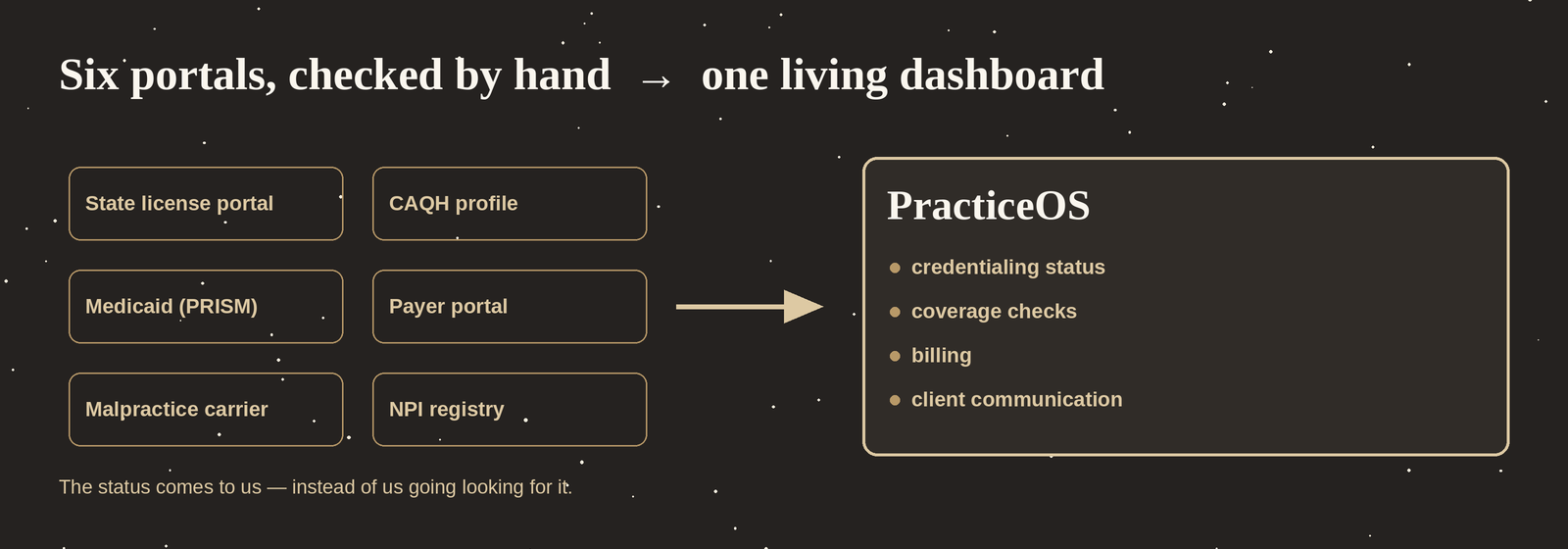
We call it PracticeOS. The Healing Haven is its founding practice — every piece of it gets built here and proven on real clients, real payers, and real deadlines before it's anything else. And it's started growing past our own walls, because it turns out every small practice is drowning in this exact same paperwork, alone, in the exact same way.
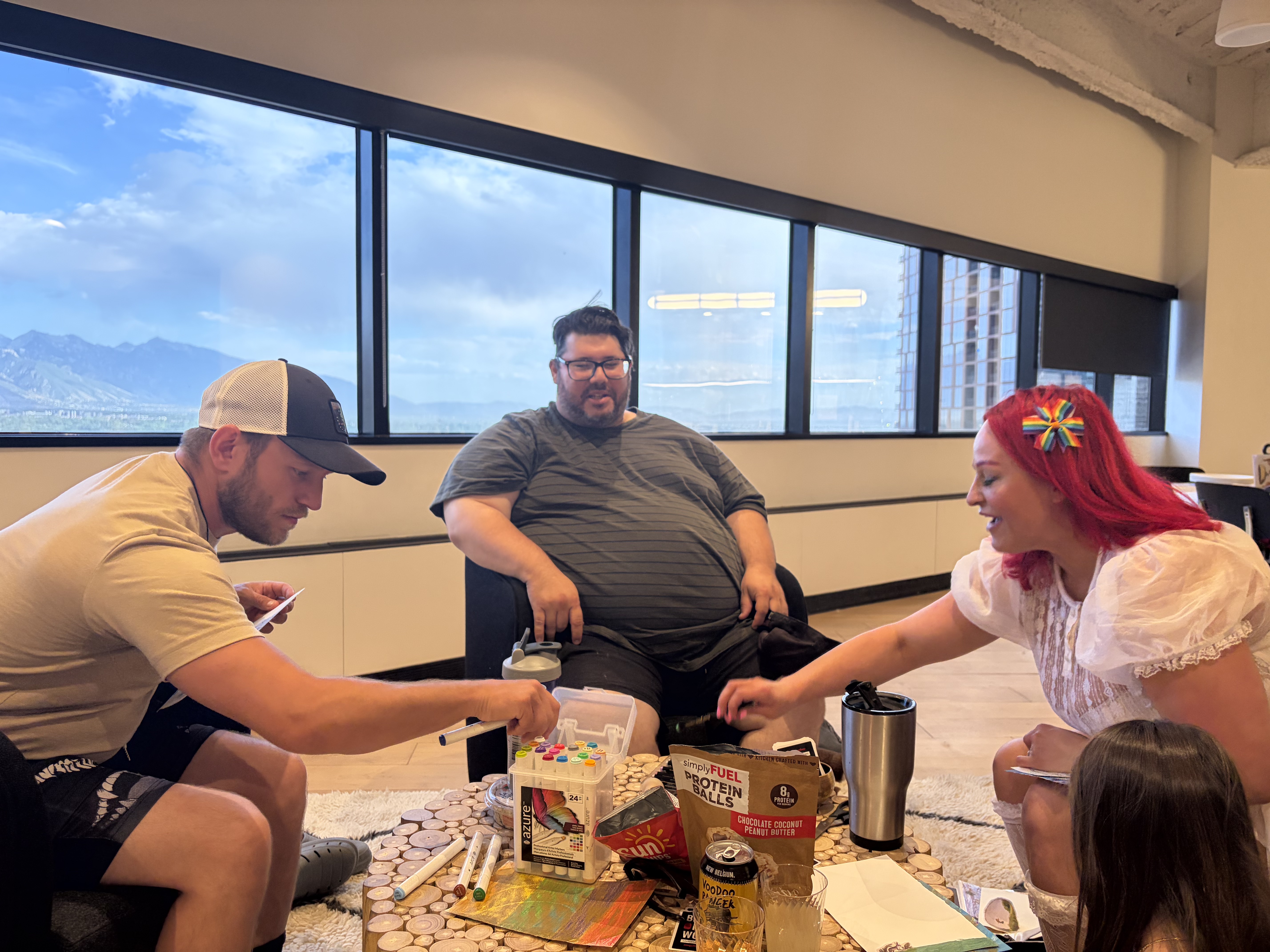
That's a story for another post. What matters here is what it changed for the people trying to get in.
What that means if you're the one waiting
Here's where things actually stand at The Healing Haven, in plain language:
Utah Medicaid
There's a specific coverage path for Medicaid clients. If you're covered, your cost is $0 — no private payment is collected from Medicaid clients, ever. Coverage and fit get verified before anything is scheduled, which is exactly the check that keeps people from ending up with a surprise later.
Commercial insurance
Right now I'm out-of-network with commercial plans — I'm inside that same credentialing process I just described, and this time it's being tracked properly. In the meantime, "out-of-network" shouldn't automatically scare you off. Many plans reimburse a real percentage of out-of-network mental health care — you pay the session rate, I give you a superbill, and you submit it to your plan for reimbursement. Some people get back a meaningful chunk. Some get back nothing. The only way to know is to check your specific plan, and I'll check it with you for free before you commit to anything.
Paying directly
A session is $189. Healing Membership starts at $97/month, which includes group access, the member community, and a session — and active members can request additional sessions at $123 when my calendar allows. You can compare the payment options here or look at the memberships.
The free coverage consult
This is the one I'd actually start with. Before you book a full session, before any card gets charged, we sit down and figure out what your coverage will and won't do. No cost. No obligation. If the answer is "this isn't affordable for you here," I would rather tell you that in a free fifteen minutes than after you've paid for a session.
The thing I want you to take from this
You were never the problem.
The wait you ran into is real, and it's structural, and it has almost nothing to do with how deserving you are of help or how quickly you asked for it. It's a system built for large hospital networks that small practices have to squeeze themselves through anyway.
I can't fix that system for everyone — not yet, anyway. I could refuse to let it be the reason someone in Salt Lake City doesn't get care with me. So my team and I built our way around it, and we're writing down the journey as we go.
If you've been putting this off because the last round of phone calls went badly, try one more.
Start with the free coverage consult. Let's find out what's actually possible for you.

The Healing Haven SLC, 250 E 200 S, Suite 1521, Salt Lake City, UT 84111 · (385) 443-4045
This post shares general information about insurance, credentialing, and pricing. It is not medical or clinical advice. If you're in crisis, call or text 988 (Suicide & Crisis Lifeline) — free and available 24/7. If it's an emergency, call 911.
Helen De Lovely, LCSW, is the founder of The Healing Haven in Salt Lake City — the founding practice of PracticeOS — where she works with clients on trauma, adult ADHD, and nervous-system healing through EMDR and somatic approaches. Zack Scriven is Practice Growth Director; Sonja Scriven is Group Practice Manager and product manager for PracticeOS.